The Internet of Bodies Wants To Hijack Your Biofield | Chris Crutchfield, Biopsy of a Psyop, 67









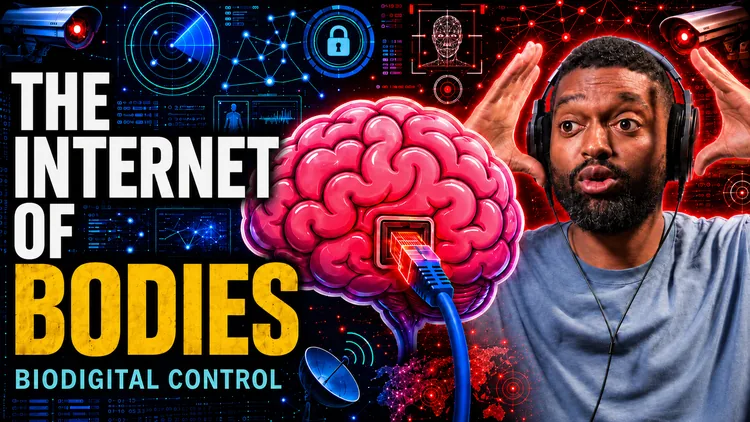
Chris Crutchfield joins InnerVerse to explain the ultimate conspiracy: the deployment of an internet of bodies that plugs your biofield into the grid. In his new documentary, "Biopsy of a Psyop, See," the six foot seven host of the 67 Podcast Chris Crutchfield drew the map that shows how banking sits at the dead center of a compartmentalized plan to digitize your biology, your biofield, and ultimately your soul, through what its architects call the biodigital convergence.
We break down the IEEE 802.15.6 Wireless Body Area Network standard that treats the living human body as a transmission medium, and how it sits two iterations away from Bluetooth by design. We cover full spectrum dominance, transhumanism, smart dust, the digital twin, ARPANET, and Klaus Schwab's fourth industrial revolution claim that you are the technology. As a working Biofield Tuning practitioner, Chance questions whether anyone can truly write to the human biofield, drawing the line between the materialist science of bioelectricity and the consciousness that actually forms the field.
 Plus+Full episode · 2h 32m
 InnerVerse Plus+
Hear the full 2h 32m episode
72 more minutes of this conversation, plus the complete Plus+ archive, premium video and a private podcast feed for your app.
Cancel any time.

Get tuned with Chance
Tuning forks find where energy is stuck in the field around your body and bring it back into flow. Sessions over Zoom, recorded for you to keep.
30 Minute Consultations
Have something to look at, or looking for guidance? We can consult oracular tools, read your chart, or just talk through whatever you choose.
In this episode
Core themes
Banking At The Wheel's Hub
Crutchfield traces his map back to a single sheet of paper sketched during a live stream and finished on an iPad on the way to Confluence 2025. It became the spine of Biopsy of a Psyop, a wheel with banking at the center and eight spokes: pharma, food, education, entertainment, technology, politics, history, and religion. Drawing on his decade of Los Angeles film work from 2010 to 2020, he argues these sectors quietly do each other's dirty work, pointing to pharmaceutical advertising money underwriting television. Garton highlights the summary line that ties it together, that the whole story is about how we categorize energy.
Smart Dust And Full Spectrum Dominance
The phrase biodigital convergence is not his own, Crutchfield notes, attributing it to the United Nations, the World Economic Forum, and standards bodies such as the IEEE, and linking it to Klaus Schwab's fourth industrial revolution and the claim that you are the technology. He describes a planned merging of biological and digital life, with blockchain acting as a translation layer, carried by pervasive grids of smart dust, particles he characterizes as specks with IP addresses and MAC identifiers. He cites full spectrum dominance, a stated goal in an early 2000s US Army manual, and argues ARPANET was built for this from its inception.
Digital Middlemen And Human Servers
Garton frames the endgame as middleman economics, an exponential new layer of tolls inserted between every organic exchange of energy, from breath to carbon to cellular function, plus enormous data sets harvested along the way. Crutchfield agrees and pushes further, arguing that today's data centers are a stopgap and the real aim is making each person the server that processes their own data, repaid in carbon credits or currency. Their sharpest illustration is hypothetical: if anyone could sit between your body and its own insulin, both men say, they would charge a subscription. The corporate move, Crutchfield adds, is to steal the real and sell back an imitation.
Antenna Versus The Digital Twin
Here Garton pushes back as a Biofield Tuning practitioner who reads human energy fields every week. Working from the hermetic idea that all is mind, he argues the biofield is not emitted by the body but forms it, closer to psyche than to hardware, so nothing can simply be written into it. Crutchfield concedes and sharpens his own claim: the biofield is only input and output, like a network card that moves data without processing or storing it, while the digital twin is what gets written to. He reaches for the two wine glasses demonstration, where rubbing one rim sets an identical untouched glass humming, as his picture of entrainment.
Standards Bodies And Background Daemons
Garton lays out the paper trail. The 802.15.6 wireless body area network standard, released in February 2012, describes using the living human body as the transmission medium; Thomas Zimmerman's personal area network research at MIT dates to 1995; and RAND's 2020 report on the internet of bodies catalogs devices that connect the body to networks along with what it calls governance gaps, which Garton reads as openings for gatekeepers. Crutchfield notes the standard sits two steps from Bluetooth, closer than Bluetooth is to Wi-Fi. Their tangent on computer daemons, background processes born when a parent forks a child, becomes a shared metaphor for the split-off psyche.
Quotes
“They trying to connect your ass to the internet. They want to call it the internet of bodies.”
“So the biodigital convergence is their term for the planned coalescence, the merging of all things biological and interfacing with all things digital.”
“It's always been the corporate move is to steal the real and sell you back an imitation.”
“Your biofield is not something emitted by your body. Your biofield is something that forms your body.”
“The biofield is just the IO. The digital twin is what they're writing to.”
“Governance gaps aka places where we could put a gatekeeper or a middleman.”
“Your human field is closer in the data standard to Bluetooth than Bluetooth is to Wi-Fi.”
“When you actually try to use occult forces to dominate or bypass someone else's will, there's a rebound effect on you. The realm is designed to prevent that kind of stuff.”
Chris Crutchfield researches the intersection of the human biofield and surveillance technology, known online for his "Biopsy of a Psyop" commentary on the Internet of Bodies.
See all Chris episodes→Kyle and Serena Denton are community herbalists creating wild-crafted and organic plant medicines out of Milwaukee since 2015. I have used their teas and tinctures on an almost daily basis for years now. Kyle is a great friend of InnerVerse and has appeared on the channel more times than I can count. These products work, not in the allopathic "pharma-medicine" way, but in a terrain-support, consciousness bolstering plant-teacher sort of way.