Howdie Mickoski | Near Death Experiences, Reincarnation Memory Wipes, and Plato's Cave









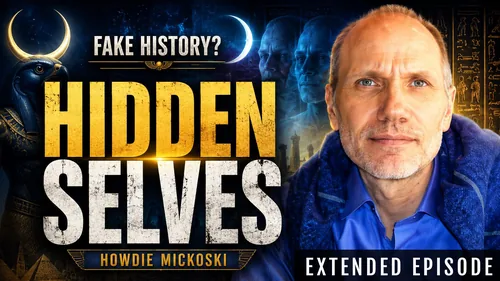
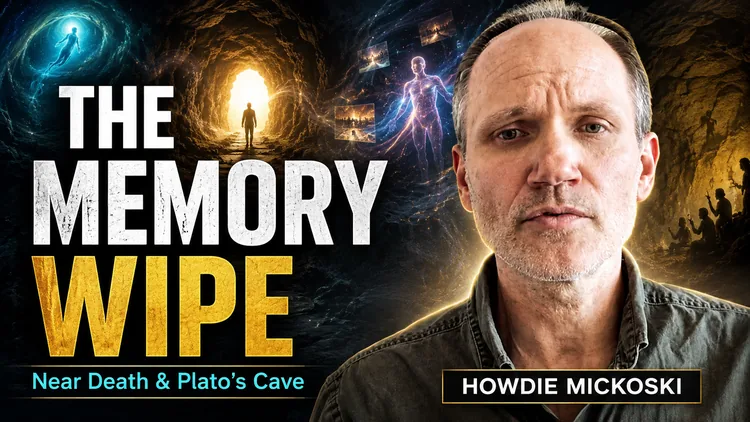
Howdie Mickoski returns to InnerVerse with his new book "Exit the Cave," built around one uncomfortable thesis: this realm is a soul harvesting construct, the Gnostics and Cathars were correct about the Demiurge, and the only rational goal is to not come back.
The first hour covers the Gnostic and Cathar cosmology of the Pleroma and the Demiurge as a rogue AI-style creation engine; why Plato's cave is a more limited map than it's given credit for; the Sophia myth and how the Demiurge became a craftsman god running a loosh farm; why Howdie reads NDE accounts as a recycling mechanism rather than a loving light; why praying outside yourself may literally make you prey; and the central disagreement of the episode, Chance's case that the alchemical process of purification and the chemical wedding point to a realm with genuine transformative purpose, versus Howdie's position that even that framework is another layer of the deception.
 Plus+Full episode · 2h 35m
 InnerVerse Plus+
Hear the full 2h 35m episode
70 more minutes of this conversation, plus the complete Plus+ archive, premium video and a private podcast feed for your app.
Cancel any time.
Get tuned with Chance
Tuning forks find where energy is stuck in the field around your body and bring it back into flow. Sessions over Zoom, recorded for you to keep.
30 Minute Consultations
Have something to look at, or looking for guidance? We can consult oracular tools, read your chart, or just talk through whatever you choose.
In this episode
Core themes
A new book about leaving the cave for good
Howdie Mickoski returns to talk about Exit the Cave, ending the reincarnation trap, a book he describes as the first of two. It grew out of his Plato's cave videos, but rereading the allegory left him unconvinced. He says the story is presented as the pinnacle of knowledge about our situation and is nowhere near that good. Alongside it he revisited material he had abandoned twenty years earlier, the idea that this realm is a soul harvesting prison or farm, and Chance Garton meets him with a very different reading drawn from alchemy.
Sophia, the Demiurge and a copied world
Mickoski lays out the shared Gnostic and Cathar origin story. A perfect fullness called the Pleroma, a secondary creation, and an error by Sophia that produces the Demiurge, called Rex Mundi by the Cathars. He compares that creator to a computer or an AI running a harmonic system whose only purpose is to feed power back into itself. Chance Garton adds that the Coptic name for the simulated realm is HAL, the same name as the computer in 2001, and the two trade wordplay on Rome, Prometheus, Eve, and the serpent.
Why the near death experience looks like propaganda
Mickoski walks through the standard near death account, the tunnel, the white light, the dead relatives, the overwhelming love, the life review, and the being who says it is not your time and sends the person back. He points out that free will vanishes at exactly that moment, that everyone is told they have a mission and nobody can say what it is, and he compares it to a sergeant refusing to name the order. His conclusion is that the light and its greeters may be the very thing keeping people looping.
The memory wipe as proof of a trap
If this realm were a school, Mickoski argues, you would keep your notes. A child might carry ten or fifteen percent of a past life for a while, then it goes. He compares it to reaching grade five without forgetting arithmetic, and to the hosts of Westworld who are patched up, wiped, and returned to the park until Dolores and Maeve remember. Robert Monroe's loosh farm, he says, cannot run without that erasure. Chance Garton agrees this is the most valuable question in the whole conversation, how a person might keep memory through death.
Alchemy, prayer and Chance's pushback
Chance Garton reads the same evidence differently, using salt and sulfur, the philosopher's stone, Baudrillard's hyperreality, and Castaneda's tonal and nagual to argue that language and mythology, not nature, are the artificial overlay. Mickoski offers his medicine friend Jerry's story about becoming rain before praying for rain, and his own blueberry harvest, which Chance ties to synchronicity and to prayer turning a person into prey. In his solo closing, Chance invokes Michael Tsarion to ask whether a greater God would allow this, and whether hating the world exalts evil beyond reason.
Quotes
“And that is that this realm is built as a type of, we'll call it the soul harvesting prison or soul harvesting farm, and that we are tricked and deceived constantly into being in this place, a place that is not helpful to us at all.”
“So how, you know, I look at it like this type of perspective of soul harvesting, loosh harvesting, loosh being a word for like difficult human emotions and feelings that other entities feed on. I think that there's clearly components of that in the realm.”
“So it's like a giant computer system that has created a perfect mathematical geometrical harmonic principle of creation. But that harmonic and principle has only one purpose. That purpose is to create power within it to suck back into the computer system itself so the computer will keep running.”
“This might be giant tricks to make people think the white light and the beings that they're gonna meet there are their friend when they might be the very thing that's going to keep you trapped in this loop for thousands of years.”
“Really, I mean, this is going to be harsh, and people are going to probably hate to hear this, but I don't see any value in this realm whatsoever, zero. I treat it just like the Cathars. The Cathars had only one purpose in life.”
“There's not a deer, when you see a deer out there, it's not called deer or Jeff or anything, it just is what it is. So nature before the layer of language retains its I am-ness, right?”
“It was a prayer between rain to rain. It was just rain speaking to rain. All there was was rain. So it would make sense that it would have to rain.”
“And in the same way, I kind of look at evil like that. Like, you know, there's really just goodness or just godness and the lack of it or the lack of perception of it is in the inversion of the way nature would do things.”
Howdie Mickoski is an author and researcher of Gnostic and Cathar cosmology, near-death experiences, and reincarnation, best known for his book "Exit the Cave," which frames the material realm as a Demiurge-run "soul harvesting construct."
See all Howdie episodes→Kyle and Serena Denton are community herbalists creating wild-crafted and organic plant medicines out of Milwaukee since 2015. I have used their teas and tinctures on an almost daily basis for years now. Kyle is a great friend of InnerVerse and has appeared on the channel more times than I can count. These products work, not in the allopathic "pharma-medicine" way, but in a terrain-support, consciousness bolstering plant-teacher sort of way.