The Empire of Baal Part 2: The Celts, Beltane & the Phoenician Connection









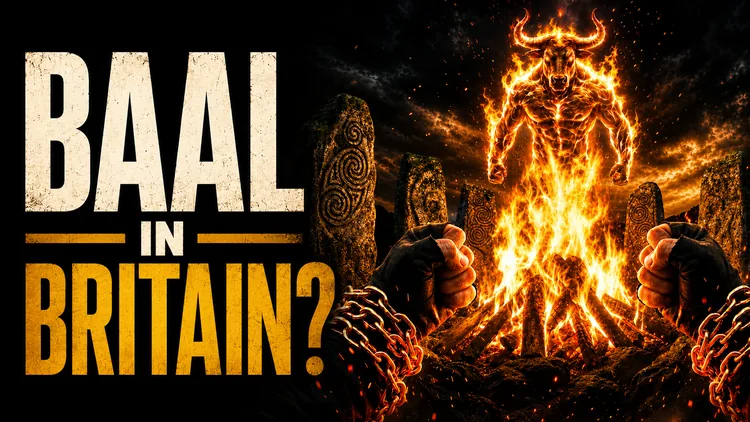
THE EMPIRE OF BAAL continues. This episode follows the golden thread westward into Celtic Europe, tracing the bull god's fingerprints across Ireland and Britain.
What do Celtic mythology, Beltane, and the ancient Phoenicians have in common? In Part 2 of The Empire of Baal, Chance Garton and Dylan Saccoccio follow the linguistic and ritual signature of the bull god Baal across the ancient world, from the Mediterranean into Gaul, Britain, and Ireland, tracing a continuous system of ancient religion preserved across thousands of years and thousands of miles. Topics include the Celtic god Belenus and his philological identity with Dionysus, the shared origin of Beltane, Walpurgisnacht, and Ash Wednesday as fire festivals, the linguistic parallel between ancient Phoenician and Irish, the etymology of Pharaoh, pyramid, and Baal, the bull and Taurus symbolism throughout the Old Testament, and the gods Adonis, Bacchus, and Mithras as regional expressions of one ancient system. The members' half is jam packed, including the Baal connection to Sibyls, government, and the technological surveillance state. This is where Baal jumps out of history and reveals its ubiquity in our modern society.
 Plus+Full episode · 2h 47m
 InnerVerse Plus+
Hear the full 2h 47m episode
78 more minutes of this conversation, plus the complete Plus+ archive, premium video and a private podcast feed for your app.
Cancel any time.

Get tuned with Chance
Tuning forks find where energy is stuck in the field around your body and bring it back into flow. Sessions over Zoom, recorded for you to keep.
30 Minute Consultations
Have something to look at, or looking for guidance? We can consult oracular tools, read your chart, or just talk through whatever you choose.
In this episode
Core themes
The Golden Thread of Baal
Chance Garton opens with an infographic he calls the golden thread of Baal, a key to what he terms the ancient ecclesiastical feudal system, the church hierarchy that governs the governors. The thread runs through bull, ox and cow symbolism and through any word built on B and L, since B trades with V, P and F while L drifts to R or N, letting bell, bull, bail, bill and Baal read as one family. Dylan Saccoccio adds the Phoenician capitals Tyre and Byblos, tzur meaning rock, lord and god, and Adonis, the dying and rising god of spring whose name simply means Lord.
Limitless Fire and the Bill
The Greek pyr means fire, and Chance argues that the familiar P to B and R to L shifts fold it back into Baal, so pyramid reads as limitless fire, which he ties to the pyramid added to the back of the dollar bill in 1935 as money became limitless fiat debt. Dylan links par and pharos to the towers of Sardinia and the Pictish brochs, at once fortresses, temples and lighthouses. Since faro is a lighthouse and farro is grain, Chance calls Pharaoh the bull lord of the grain whose fire guides, while the bull sacrificed to settle a debt becomes the bail a prisoner pays.
Baal Peor Becomes Balfour
Reading Numbers 25 aloud, Chance stresses the heads hung before the sun and the twenty four thousand dead, calling the chapter atrocity propaganda parked in front of something the compilers preferred hidden, and noting that plaga once meant to strike or wound before the Vulgate made it mass death. Dylan checks the Hebrew and finds Peor spelled with a vav, closer to pur, fire, and par, bull. Both then reach the Balfour Declaration of November 2, 1917, Arthur James Balfour writing to Lord Lionel Walter Rothschild, and Dylan contends that Semite is a category invented around 1800, with Porphyry calling Israel a Phoenician name for Kronos.
The Irish Phoenician Trail
Turning to the Celts, Chance holds that Celt and Gaul name one people through a C and G swap, and that the Phoenicians of the record are the Etruscans, Tyrrhenians and Pelasgians of the Italian peninsula rather than Levantine migrants. Dylan offers cel or kil as stone, the root behind church and behind the standing circles, so that asking whether someone had been to the stones meant asking whether they had been to church. The two read Charles Vallancey, who published in the early 1800s that the chief deity of the heathen Irish was Baal the sun, with May named the month of Baal's fire.
Bellanus and the Beltane Fires
Encyclopedia Britannica gives Bellanus one paragraph, possibly Bright One, tied to pastoralism and to the May 1 fire festival, yet denies he was a sun god, a hedge both hosts treat as deliberate suppression, while Wikipedia centers him on Aquileia in northeast Italy, identifies him with Apollo and links him to healing springs. Dylan reads the suffix nous as mind, making Bellanus a double of Dionysus. Chance then walks the same rite through Walpurgisnacht on April 30 and its saint, through the maypole, through the Balkan Yarilo and the twelfth century Yarovit, and through the Persian Chaharshanbe Suri that he sets beside Ash Wednesday.
Quotes
“I'm calling it the golden thread of Baal, a major key to the ancient ecclesiastical feudal system.”
“But that word specifically means rock. So there's a connection between rock and father and lord. And you also see it with Peter and Petra.”
“It's part of a pyramid scheme, a pyramid system that sets each level of a hierarchy up as the lord or god of the level below it.”
“Pharaoh is the bull lord of the grain whose fire guides. All of that concept is in the word pharaoh.”
“The actual definition of a Semite means to be descended from Shem, Noah's son.”
“There's even a saying people said, "Will you go to the stones?" It's basically like saying, "Will you go to church?"”
“The Scottish and Irish used to once be the same culture. So it's embedded in there. But because of the Irish's isolation, their language preserves it the most.”
“Almost everything that they call a saint, right? Catholic saints are repackaged versions of pagan deities.”
Dylan Saccoccio is the author of the Spirit Whirled series, The Real Universal Empire, and the Tale of Onora. After chasing language back as far as possible, he now explores other avenues to prove cultural diffusion of the ancient universal empire of priests, navigators, masons, and merchants. Find his latest of many hundreds of articles on Substack.
See all Dylan episodes→Kyle and Serena Denton are community herbalists creating wild-crafted and organic plant medicines out of Milwaukee since 2015. I have used their teas and tinctures on an almost daily basis for years now. Kyle is a great friend of InnerVerse and has appeared on the channel more times than I can count. These products work, not in the allopathic "pharma-medicine" way, but in a terrain-support, consciousness bolstering plant-teacher sort of way.