Kingdoms, Kings & Crosses with Mario Garza of Symbolic Studies









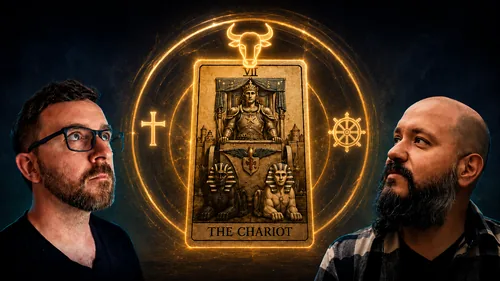
The sedulous loremaster of Symbolic Studies, Mario Garza, returns to Vibe Rant to share some of his ever evolving seasonal researches. Why are classic versions of the Emperor Card in the Tarot depicted as mountains? What does the archaic allegorical archive advise us about the sacred center of our realm and of ourselves? Kings, crosses, rams, and the wisdom of Aries are in the mix for tonight's synchromystic show!
 Plus+InnerVerse Plus+
 InnerVerse Plus+
Hear every full episode
Every extended episode, the complete Plus+ archive, premium video and a private podcast feed for your app.
Cancel any time.

Get tuned with Chance
Tuning forks find where energy is stuck in the field around your body and bring it back into flow. Sessions over Zoom, recorded for you to keep.
30 Minute Consultations
Have something to look at, or looking for guidance? We can consult oracular tools, read your chart, or just talk through whatever you choose.
In this episode
Core themes
The King at the Center of the Cross
Mario Garza opens the weave by arguing, following Rene Guenon's The Great Triad and The King of the World, that ancient kings understood themselves as the bridge uniting Heaven and Earth, seated at the crossing point of a kingdom quartered into north, south, east and west. He cites John Michell's At the Center of the World for kingdoms literally divided by a north south and an east west road, and reads the Rider Waite Emperor card as a central mountain flanked by two peaks. In his telling the king aspires to be the unmoved mover, still at the axle while the wheel of cycles turns.
Polar Symbolism Came Before Solar
Garza contends, citing Guenon, that polar symbolism is the older and more primordial layer, that a counterclockwise turn like the stars around the pole star returns to the center while a clockwise turn is solar and expansive, and that the pole star is the axle of the wheel of heaven. Chance Garton offers his own cosmological conjecture, flagged as conjecture, that the Earth grows rather than spinning through a vacuum, and he brings up reported underwater lakes and shores as a possible density boundary, treating the vertical z axis as an axis of density where submersibles bounce off denser water.
Kings, Crosses and the Philology Goggles
Garton walks through words for king across languages: basileus in Greek, rex and lex in Latin, rey, re, roi, krol, kral, Konig, wang, o and melech. He proposes that R and L interchange, that X trades with S and C, and that a hard aspirate turns the French roi into croix, or cross, noting European rei against Brazilian hey. He links Hebrew cohen with khan, and ras or rosh, meaning head, with rex and the Ethiopian ras, then follows basileus into the basilica, the basil leaf, vassals, the basilisk and the Bank for International Settlements in Basel.
The Sacrificed King and the Crucified Savior
Garza describes a long pattern of the king who is killed when he stops pulling his weight, with the jester dressed as king and ritually mock killed in springtime, and the wandering prince or Fool arriving from outside to dethrone him, all of which he ties to Aries as cardinal fire and sacrifice. Garton reads Ixion, bound to a fiery wheel, as in his view one of many crucified saviors predating Jesus, quoting the author he cites as Nimrod, and Pindar, on the wheel as a Saint Andrew's cross, and adds Saint Eulalia, martyred on that same X shaped cross in 303 AD.
Losing the Center, and Finding It Again
Garza argues that what marks a dark age is the loss of the center, that people feel ungrounded because everything now runs on external validation and external solutions, and that the heart, the Rosicrucian rose at the crossing of the cross in Manly P. Hall's illustration, and the Freemasonic compass and square all point back to the same still point. Garton describes his biofield tuning practice, where he finds a client's energetic poles drifted out of alignment with their physical center through habitual thinking. Garza closes by reading the Fool as descending the polar mountain to take another turn of the wheel.
Quotes
“There really truly is a thread between the center of the cosmos, the center of Earth and the center of self. It's actually the same point.”
“The huge variety and multiplicity of gods and goddesses seems to be mostly expanded out of misconceptions about adding new gods based on epithets or titles or other languages or letter swaps.”
“The outward projecting clockwise spiral that's going out further and further, and then the inward spiraling corkscrew feminine energy, those are both simultaneous forces in our world, in our bodies.”
“Humanity doesn't share a consensus up or a consensus down, and I'm starting to understand that we actually all share the same up and the same down.”
“This concept of the king as the bridge between worlds, it is so embedded in our psyche, and it's not always just the king per se, but it's the hero.”
“There is so much to talk about with the sacrifice of the king, the killing of the king, and this idea that if a king isn't pulling his own weight that he can be sacrificed.”
“The Bank for International Settlements is in Basel, Switzerland. There's your king idea and center idea, and this is the central bank for central banks.”
“I use the word pole these days. When someone's giving away their power, I say that they are giving away their pole, and that they should really be holding on to it.”
“There's similarities symbolically between the hand and the heart, that they're emblems of this creator king, sacrificial savior.”
“That's why we're so off-centered, that's why so many people are completely ungrounded, because everything is operating on sort of an external level, everything is about external validation.”
“This was not just thoughtless pop culture. There's some weird hidden hand behind this stuff, or it's just synchromystic and it's embedded in the framework of people's creative consciousness.”
“What I'm starting to see with the Fool coming down the mountain is that he's actually descending the polar mountain, the central mountain that the emperor is associated with.”
Mario Garza is the artist and researcher behind Symbolic Studies, a project sharing symbolic insights on the zodiac, mythology, folklore and world religions, with astrology as its foundation. A lifelong artist who has worked as an art director and graphic designer for nearly 25 years, he runs Symbolic Studies from the Pacific Northwest alongside his wife Michelle, who co-hosts the podcast with him. His work traces syncretic threads across tarot, occultism and comparative religion, including the argument that the major deities of antiquity were originally polar gods before a solar model was laid over them. He also offers symbolic birth chart and tarot readings, private lessons and freelance design.
See all Mario episodes→Kyle and Serena Denton are community herbalists creating wild-crafted and organic plant medicines out of Milwaukee since 2015. I have used their teas and tinctures on an almost daily basis for years now. Kyle is a great friend of InnerVerse and has appeared on the channel more times than I can count. These products work, not in the allopathic "pharma-medicine" way, but in a terrain-support, consciousness bolstering plant-teacher sort of way.