
Verbal Judo, Tactical Communication, & Social Engineering with Slick Dissident









Tonight we'll be demystifying the work of the late George "Doc Rhino" Thompson, known by police cadet trainees and corpo-ladder climbers as Verbal Judo. What are the effective tools for communication for conflict de-escalation? What do society's occult engineers know about manufacturing consent and self-incrimination? Join Slick Dissident and me for a look at the good, bad, and ugly of tactical speech.
 Plus+InnerVerse Plus+
 InnerVerse Plus+
Hear every full episode
Every extended episode, the complete Plus+ archive, premium video and a private podcast feed for your app.
Cancel any time.
Get tuned with Chance
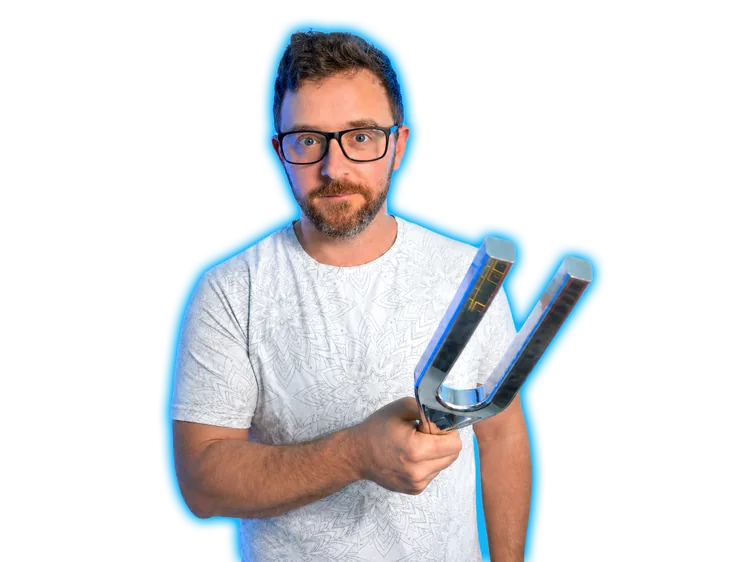
Tuning forks find where energy is stuck in the field around your body and bring it back into flow. Sessions over Zoom, recorded for you to keep.
30 Minute Consultations
Have something to look at, or looking for guidance? We can consult oracular tools, read your chart, or just talk through whatever you choose.
In this episode
Core themes
Verbal Combat as a Martial Art
Gabe, who broadcasts as Slick Dissident, argues that the great philosophers habitually framed ideas as martial combat, claiming that Socrates was a skilled swordsman, observing that the first Academy was built on the grounds of a gymnasium, and pointing out that Schopenhauer compared debate to sword fighting. He sees the etiquette of old German fencing schools laid out inside Verbal Judo. Chance Garton adds the Celtic Ogmios, a Hercules figure whose golden chains ran from his lips to the ears of his followers, as an ancient picture of conquest through eloquence, which he calls the heart of what Verbal Judo is really about.
Doc Rhino and the Cost of Self-Abandonment
Chance Garton introduces George "Doc Rhino" Thompson, an English PhD with post-doctoral study at Princeton who, as Chance tells it, left a professorship at 35 and joined the police to learn how officers talk people down. Chance credits the method with de-escalating real conflicts, but questions its core instruction to train yourself to do the opposite of what you feel or want, arguing from his biofield tuning work that this kind of suppression carries an energetic toll. Gabe describes older seminar footage, since removed online, in which he says Thompson coached officers to abandon even their uniformed persona and switch into a machine with the mantra "showtime baby."
Tactical Language, Names, and Self-Incrimination
Thompson's taught rule that natural language is disastrous and tactical language is a performance becomes a springboard for both hosts. Chance Garton contrasts living natural language with what he calls the dead, contract bound language of legalese, and frames citizenship as a contract to perform. Gabe argues that an officer's opening lines are designed to walk a driver past the first four amendments toward giving up the Fifth, and recalls Thompson describing naming as a kind of black magic. Gabe's counsel is to stick to those five, run the clock, and remember that the officer is the one on paid time.
Deflection, Paraphrasing, and Empathy
Chance Garton walks through Thompson's tools for verbal assault: mushin, or a still center under attack, protecting the other person's face, strip phrases such as "I understand that" followed by a redirect, and paraphrasing back exactly what was said. He calls strip phrases dishonest yet effective, while praising the principle that empathy absorbs tension, and applies these ideas to close relationships and to parenting a child at bedtime. He links them to a lesson from his biofield tuning practice, that accepting is protecting. Gabe answers by flipping the playbook, suggesting citizens repeat "calm down" and keep a receipt book during traffic stops.
Questions, Compliance, and the Inner War
Reading from Thompson's book, Chance Garton sorts question types and highlights the claim that opinion seeking questions generate compliance, which he argues extends to polling and voting. He seizes on Thompson's definition of con artistry as raising expectations in order to cheat, and retracts his own past advice to soften criticism with flattery. Gabe ties fact finding to what he calls the boondoggle, where the state keeps the benefit and the citizen keeps the liability, then lists confidence builders like knowing local lawyers and recording encounters. Chance closes by arguing that outer conflict mirrors a war between left brain and right brain.
Quotes
“A lot of people like to think of verbal conflict as separate from, or even removed from, physical confrontation, but the general parameters of the modality of how you conduct yourself is all the same. It's all the same arena.”
“I had a false formula, that the costume that the officer puts on, I used to believe that that was the persona, that was the mask, that's the state issued ID that they go on to go as an actor on the stage. But I think I'm realizing there's another level beyond what we call personhood.”
“The internet is not the living, breathing, eternal entity that you might kind of see it as. If there's something that interests you or that you find to be rare and helpful information, save it offline.”
“Training yourself to do the opposite of what you feel or what you want, that is not healthy for your biofield energy, and especially if there's major cognitive dissonance that's following out of that, you're going to wind up with some sort of dysfunction, injury, disease, problem.”
“Another thing you have on your side is time. You're not getting paid to do this. You're not privileged by money to stand here and talk. You're not getting privileged by money. They are executing privilege because they're getting paid to jack your life. So you just run that clock.”
“The state has no energy itself. It's made up of people whose energy is redirected. There is no such thing as a group or collective. Those are fictional concepts, those are abstractions. And as a corporate entity, does the state or any other corporation have the capacity to get upset? No, it doesn't.”
“If they throw the insult at you and you don't respond to the insult, or you don't get the emotional riled up about it and then throw attack back with an insult, then the spear has now sailed harmlessly past you. It's stuck in the wall and they don't have that weapon anymore.”
“The power differential is an illusion. They've got these guns, they've got the armor, they've got buddies, but they are bound by duty. We have rights, which are not our... that's not our limitation.”
“Validating other people's experience actually gives you power in a way that our generation and the generations to come might lose their opportunities by not validating the experiences of others.”
“In your internal life and internal world, the best protection you've got against other people's negative energy is being okay with the fact that they've got it. It is what it is.”
“I learn how they work and I realize that not only are we able to do the same, we actually can do way more than they're allowed to.”
“I promise you it is safe and effective to live based on only what is a full authentic, full body hell yes, and saying no to other stuff.”
“Notice none of that had anything to do with life-threatening. There is no life-threatening advice in that. Isn't that amazing, that we don't need violence? We just need wit.”
Gabriel, known on air as Slick Dissident, co-hosts InnerVerse's Vibe Rant show and is a longtime recurring guest on the podcast. He teaches occult symbolism and tarot on his YouTube channel, ranging across the Major Arcana, the esoteric Enneagram, mythology and archetype, mystic linguistics, and the symbolism hidden in popular film. He is best known for Tarot-tories, his own system mapping the 22 Major Arcana and zodiac archetypes onto the geography of the United States.
See all Gabe episodes→Kyle and Serena Denton are community herbalists creating wild-crafted and organic plant medicines out of Milwaukee since 2015. I have used their teas and tinctures on an almost daily basis for years now. Kyle is a great friend of InnerVerse and has appeared on the channel more times than I can count. These products work, not in the allopathic "pharma-medicine" way, but in a terrain-support, consciousness bolstering plant-teacher sort of way.