The Great Whiteboard Brotherhood Vs Philosophical Bladesmen of the New Word Order








Get ready to be initiated into the mysteries of the Great Whiteboard Brotherhood, the mystical sync-tank of our boy Slick Dissident. Tonight we take aim at the new word order imposed by centuries of linguistic drift that's gradually transferred power from verb to noun. What happens when you use Hume's Guillotine on Occam's Razor? Just because a noun represents us, ought we believe that we are our pronouns? Prepare for profound pronouncements on the primary problems of philosophy.
 Plus+InnerVerse Plus+
 InnerVerse Plus+
Hear every full episode
Every extended episode, the complete Plus+ archive, premium video and a private podcast feed for your app.
Cancel any time.
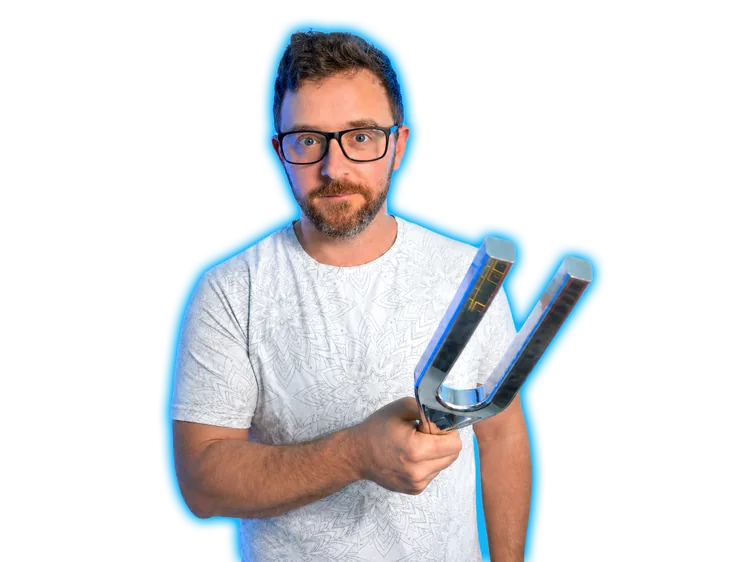
Get tuned with Chance
Tuning forks find where energy is stuck in the field around your body and bring it back into flow. Sessions over Zoom, recorded for you to keep.
30 Minute Consultations
Have something to look at, or looking for guidance? We can consult oracular tools, read your chart, or just talk through whatever you choose.
In this episode
Core themes
The First Meeting of the Great Whiteboard Brotherhood
Chance Garton opens episode 139 by initiating everyone into what he jokes is a brand new cult with three requirements: you have to be a brother, you have to be great, and you have to own and use a whiteboard, which he has finally done. He describes the Great Whiteboard Brotherhood as a sink tank rather than a think tank, a synchronicity driven crew whose name he thinks Paranoid American may have coined, played against the esoteric Great White Brotherhood. Returning guest PK joins Gabe (Slick Dissident) for a laid back research hangout, with call ins to the vibe rant hotline and super chats from Liam and Ari.
Verbs, Nouns and the Babylon Mentality
Gabe traces the night's current back to a show he did with George on Third Eye Edify, where he walked the Odyssey through the Enneagram in reverse, noting that the first word of the poem, mania or rage, is an anagram of Enneagram. From there he argues that ancient Greek placed control in the verb rather than the noun, that the letter row, number 19 in Greek, became our possessive apostrophe S, and that surnames ending in O R or E R still mark what a family does for a living. He calls the noun heavy paradigm Babylon mentality, where your possessions own you.
Jung, Synchronicity and Manufactured Facts
Chance argues that facts are constructions, pointing out that fact descends from the Latin facere, meaning to make or fabricate. Reading Carl Jung more closely, he relays Jung's conclusion that the greater part of the psyche lies outside the personal self, so the consensus world is the densest and least budgeable layer of mind. His case study is the 1947 pilot he names as Keith Arnold, who said nine luminescent craft moved like saucers and was misquoted as reporting flying saucers, after which sightings broke out everywhere. Chance contends this shows intelligence operating through correspondence, and that building your own systems of correspondence takes that power back.
Hunting the Missing Digamma
PK runs eleven screenshots on the digamma, the sixth letter of the Greek alphabet, which he says went missing and was gradually simplified until it was no more than a large comma, our apostrophe. He tracks it through the stigma, the stauros or cross at 777, the Chi Xi Stigma of Revelation 13:18, and words such as Orion, anax and Aphrodite, where a lost W or V sound still leaves traces. Chance reconstructs Deus on his whiteboard as D I V O S and asks where the World Economic Forum meets: Davos. Gabe ties the number six to the Enneagram loyalist, the muse Erato and the maxim have no dogma.
Alpha to Omega, and a Closing Round of Prophecy
In the last stretch Chance puts the digamma back into the alphabet so the letter M lands dead center, links the Hebrew aleph mem tav to the Latin amo and the Hindu Om, and reads the Chi Rho as row plus tau, 200 plus 400, the 600 years he says separate incarnations of the savior. Gabe closes on Hume's is and ought problem, the replication crisis, and a 7/22 weave in which Joe Biden's withdrawal meets a new formula for pi. He predicts section three of the 14th Amendment will be turned on Trump, and says he would rather see the amendment nullified outright.
Quotes
“So we're playing our part here as the good guys behind the scenes, all communicating with the archetypes, constructing systems of correspondence.”
“I believe that language is our soul. And the more languages you speak, the more soulful you are.”
“Why would this phenomenon that exhibits lots of characteristics of intelligence, why would it change its shape and manifestation based on a description or common expectation that was presented by mistake?”
“We have a vast responsibility to access these correspondences in the context of the information, to put it into a logos that works, a theology that is working for us.”
“It's hard to comprehend what difference it would make to our thinking and behavior to have syntactical options that are not present in English.”
“If we told you what to think, then you would make it into a gospel.”
“It's just kind of an amorphous letter in that the vow form can make sounds as diverse as a U, a V or a W.”
“It meant truth or wisdom. And in the ancient system, those things, truth and wisdom, those were synonymous terms with love, divine love, divine wisdom, divine truth.”
“The poet needs to get out of their own way to let the inspiration come through them. The poets are the god makers.”
“600 is an immensely important number in the ancient system because it's the number of years in a cycle between incarnations of the Christ or the savior.”
“Your word isn't good enough. It's got to be on paper. And this is all Babylon. The material things own you as opposed to you owning material things.”
“Total solar eclipse is an anagram for Aristotle collapse. I've been looking at Aristotle very suspiciously lately.”
Gabriel, known on air as Slick Dissident, co-hosts InnerVerse's Vibe Rant show and is a longtime recurring guest on the podcast. He teaches occult symbolism and tarot on his YouTube channel, ranging across the Major Arcana, the esoteric Enneagram, mythology and archetype, mystic linguistics, and the symbolism hidden in popular film. He is best known for Tarot-tories, his own system mapping the 22 Major Arcana and zodiac archetypes onto the geography of the United States.
See all Gabe episodes→Kyle and Serena Denton are community herbalists creating wild-crafted and organic plant medicines out of Milwaukee since 2015. I have used their teas and tinctures on an almost daily basis for years now. Kyle is a great friend of InnerVerse and has appeared on the channel more times than I can count. These products work, not in the allopathic "pharma-medicine" way, but in a terrain-support, consciousness bolstering plant-teacher sort of way.