
Never Forget Conspiracy Nostalgia with Paranoid American & Slick Dissident









Paranoid American returns with Slick Dissident on the September 11 anniversary to compare nineties conspiracy culture with today's hot takes, revisit the King Kill 33 thesis, explain what a language model really does, and trace Voltaire, the Lisbon disaster and the Illuminati behind the classical composers.
 Plus+InnerVerse Plus+
 InnerVerse Plus+
Hear every full episode
Every extended episode, the complete Plus+ archive, premium video and a private podcast feed for your app.
Cancel any time.
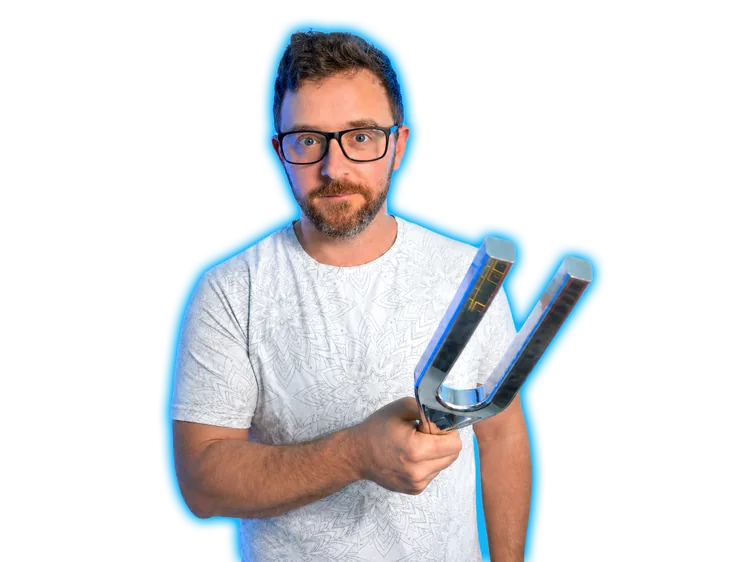
Get tuned with Chance
Tuning forks find where energy is stuck in the field around your body and bring it back into flow. Sessions over Zoom, recorded for you to keep.
30 Minute Consultations
Have something to look at, or looking for guidance? We can consult oracular tools, read your chart, or just talk through whatever you choose.
In this episode
Core themes
Conspiracy Nostalgia Then and Now
Paranoid American opens by describing a split he has watched happen over thirty years. In the early nineties, conspiracy culture ran on information rather than personalities, with names like William Cooper, Jordan Maxwell, Myron Fagan and Manly Palmer Hall pointing past themselves toward the material. Today, he argues, the scene rewards whoever lands the fastest hot take in a tweet. His answer is to slow down and build whole illustrated stories instead, which is why he calls his comics the only real way he can exorcise the ideas he cannot get across on an audio show.
King Kill 33 and the Quantum Assassination
Chance Garton and Slick Dissident walk Paranoid American through James Shelby Downard's King Kill 33 thesis, the idea that a ritual assassination always supplies at least three possible gunmen so that history chases its own tail forever. Paranoid American suggests the CIA and Sidney Gottlieb refined the technique, and that the Trump ear shot was a nonlinear version, energy taken at one man and discharged into Biden stepping down. Slick Dissident ties it back to Bellis, the Phoenician god who makes the world by cutting off his own head, and to John the Baptist on a plate.
What a Language Model Actually Does
Much of the night is Paranoid American explaining how these systems really work. He runs eighty to a hundred of his own fine tuned models offline in LM Studio, trained on everything from occult texts to comedy transcripts, and he compares a generation to dropping a marble into a shoebox of uneven sand, where a seed number decides where it settles. Nothing is stored or retrieved, only patterns replicated, so the machine invents dates and sources with total confidence. Its job is convincing output, not accuracy, which makes the operator a curator far more than a creator.
Commanding the Tool Instead of Begging It
Slick Dissident argues we should command our tools rather than ask them nicely, pointing out that future tense words like will and shall belong to whoever is giving the orders, and warning that children who watch adults say please to a chatbot will be the ones commanded later. Paranoid American counters with a finding from the training community, that courtesy really does pull better answers out of a model because it mirrors how humans treat each other. He also warns that heavy censorship neuters a model the way bowling bumpers ruin a bowler.
Lisbon, the Tower Card and the Illuminati
The episode closes on Voltaire and the Bavarian Illuminati. Slick Dissident reads the 1755 Lisbon disaster as the 9-11 of its generation, with Voltaire's poem daring the church to claim liability for God's catastrophe while Rousseau answered as the optimist, and he notes Voltaire named himself after the tower card while jailed in the Bastille. Paranoid American then previews illuminaticomic.com, made with Donut, which argues the order stood behind the child pop stars of its own day through Bach's publisher, Beethoven's teacher and the death of Mozart.
Quotes
“Now the new wave of conspiracy, it's just everyone's got a hot take and an opinion on the latest thing, and it works so much better if you can throw it out as like a little quip or 160 character tweet with like a little meme.”
“You know, I always say plant seeds for trees that you don't anticipate to eat the fruit of.”
“Why would you King Kill 33 ritual someone that's running but might not actually even end up being president? The King Kill 33 ritual has to be done on the actual king. Right. It can't be a proxy king.”
“when you understand the multivalent symbolism of cosmogonies, of the ancient mystery school traditions, wherever they're from, it's always about every creation story is also a deluge story. And every deluge story is also a creation story when you get it.”
“the way that you train any AI system is essentially through a basic system of punishment and rewards. If they try to do something and it doesn't turn out right, they get punished. If they do it and it comes out great, they get rewarded.”
“We want the kids to see us commanding our tools to bend to our will. And if we don't have that kind of mentality, the kids are going to be really bent over when the computers start commanding the children.”
“OK, so basically any information that you can get AI chat bots to admit to is information received under duress and it's not admissible in court.”
“But when you dig in and you look at the history, you're like, wait, there is a freaking historical precedent that shows they know how important music is to the culture, specifically music being created by these new up-and-coming kids that are gonna end up shaping the generation.”
Gabriel, known on air as Slick Dissident, co-hosts InnerVerse's Vibe Rant show and is a longtime recurring guest on the podcast. He teaches occult symbolism and tarot on his YouTube channel, ranging across the Major Arcana, the esoteric Enneagram, mythology and archetype, mystic linguistics, and the symbolism hidden in popular film. He is best known for Tarot-tories, his own system mapping the 22 Major Arcana and zodiac archetypes onto the geography of the United States.
See all Gabe episodes→Kyle and Serena Denton are community herbalists creating wild-crafted and organic plant medicines out of Milwaukee since 2015. I have used their teas and tinctures on an almost daily basis for years now. Kyle is a great friend of InnerVerse and has appeared on the channel more times than I can count. These products work, not in the allopathic "pharma-medicine" way, but in a terrain-support, consciousness bolstering plant-teacher sort of way.