You Can't Prove Atoms Exist, w/ PhD Steven Young (Hedflux) & Marty Leeds (Gnostic Academy)









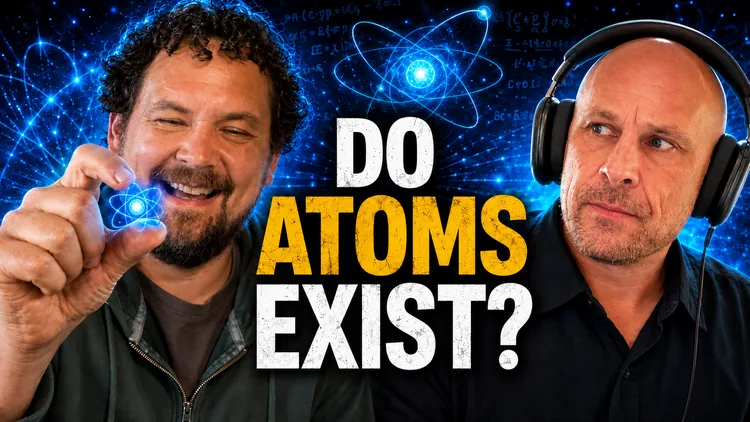
Nobody has ever seen an atom. Physics PhD Dr. Steven Young (Hedflux) and Marty Leeds of the Gnostic Academy put atomic theory and particle physics on trial. No direct observation, no repeatable experiment, no proof. In this episode we work through what the evidence for atoms actually consists of: bumps on graphs, microscopes that presuppose the atoms they claim to reveal, and a mind-spell to make you feel small. From there the conversation widens into the periodic table that is not periodic, the one proton that supposedly turns gold into mercury, Mendeleev's erased ether, the boondoggle economics of CERN, and the older map the moderns replaced: earth, air, water, fire, and the living ether.
 Plus+Full episode · 2h 5m
 InnerVerse Plus+
Hear the full 2h 5m episode
56 more minutes of this conversation, plus the complete Plus+ archive, premium video and a private podcast feed for your app.
Cancel any time.

Get tuned with Chance
Tuning forks find where energy is stuck in the field around your body and bring it back into flow. Sessions over Zoom, recorded for you to keep.
30 Minute Consultations
Have something to look at, or looking for guidance? We can consult oracular tools, read your chart, or just talk through whatever you choose.
In this episode
Core themes
Nobody Has Seen An Atom
Young says his doubts began after investigating virus claims, when he went looking for anyone who works directly with individual atoms and could not find them; physicists, he argues, run experiments, plot data on graphs, and then treat a small bump in the graph as proof of a particle, while the foundational experiments are rarely repeated or verified. Garton notes that mainstream science holds atoms to be smaller than a wavelength of light, so light supposedly bends around them rather than revealing them. Leeds adds that ion based microscopes assume atomic theory in order to test atomic theory, which he calls a circular conflict.
Quantity Cannot Make Quality
Young asks how a water molecule, an abstract diagram with no wetness of its own, produces the wetness of water, and takes the question to the periodic table: hydrogen, helium, and lithium differ by single protons, yet adding one proton supposedly turns a transparent rising gas into a soft metal dug out of rock, and gold sits right beside mercury. Garton draws on Rene Guenon's The Reign of Quantity and the Signs of the Times, arguing that qualities and essences exist before physical matter in a Platonic sense, so no count of protons could ever generate them.
Small Stuff And Nonsense
Young maps particle physics onto what he sees as an inverted alchemy: the God particle at the top, then quark and lepton, then proton, neutron, and electron, then the four states of matter, mirroring the tetractys that descends from a godhead through three principles to the four elements. He notes lepton comes from the Greek lepta, meaning tiny, while quark is a German colloquialism for something trivial, so the story tells people they are built from small stuff and nonsense. Both men read this as deliberate diminishment; Leeds calls the theories mind spells and urges seeking provable theorems instead.
A Science Without Fruits
Young cites Cambridge physicist David Tong telling the Royal Institution that particles do not exist and that everything comes from vibrations in a fluid medium, though Tong then keeps the same particles as fields. He contrasts the sprawling standard model equation with music theory, which yields endless songs, and says the God particle rests on a faint bump in a graph. Leeds applies the test of fruits to CERN, nanotech, and gene testing, calling DNA matching a database of names. Garton argues such projects also burn off surplus debt based currency while quietly feeding surveillance.
Squaring The Circle Of Elements
Young notes that Mendeleev's first table was an eight by eight grid whose opening element was the ether, called Newtonium after Newton, removed around 1905, and that the modern table lists calculated atomic masses derived from Avogadro's number rather than measured substances. Leeds argues the genuine periodic arrangement is a circle, the zodiac, so turning it into a table literally squared the circle and made spiritual things material. He ties earth, air, water, and fire to 78 in his gematria, the twelfth triangular number, matching the tarot's 22 major and 56 minor cards.
Quotes
“The actual particles themselves were never really proven. The more I looked at it, I just couldn't find evidence of it.”
“The claim from the science is that atoms are so small they cannot be seen with light. Like, light is too big.”
“In order to study atomism, you have to presuppose that atomism already works, because it's an ionic microscope.”
“Lepton means small stuff, it comes from lepta, which means very small or tiny in Greek. But quark is a German colloquialism which means something insignificant or trivial or nonsense.”
“They're presenting all these theories as if they're actually trying to figure stuff out. In my contention, it is all mind spells. It's magic spells, and that's exactly their intent.”
“It's just a little graph with a tiny little bump, and they're like, 'See that bump? That's the God particle.'”
“I got to hold a piece of uranium, and the energetic qualities of that thing were wild. It was like a really low micro dose LSD experience just holding the uranium.”
“When they made the four elements, earth, air, water, and fire into the periodic table of elements, they squared the circle, and they took all the things that are spiritual and made them material.”
Steven A. Young holds an MSci and a PhD in theoretical physics, and now describes himself as an author, musician and natural philosopher. He is the author of A Fool's Wisdom: Science Conspiracies & The Secret Art of Alchemy, which critiques scientific materialism before presenting Hermetic alchemy as a science of transformation. Under the alias Hedflux he has produced electronic music since 2003, going full time in 2010 and founding the label Luminus Music, with a body of work collected in a 20 Year Legacy Collection of 88 tracks and 12 DJ mixes. He lives in Scotland, where he teaches Audio Alchemy, a synthesis of musical, scientific and Hermetic knowledge.
See all Steven episodes→Kyle and Serena Denton are community herbalists creating wild-crafted and organic plant medicines out of Milwaukee since 2015. I have used their teas and tinctures on an almost daily basis for years now. Kyle is a great friend of InnerVerse and has appeared on the channel more times than I can count. These products work, not in the allopathic "pharma-medicine" way, but in a terrain-support, consciousness bolstering plant-teacher sort of way.