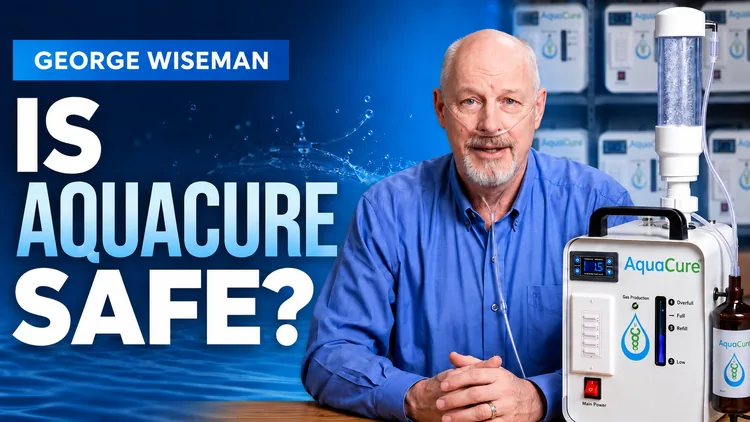
Is the AquaCure Safe? Lye, Brown's Gas, and the AC50 | George Wiseman









Inventor George Wiseman returns on hydrogen deficiency, Gerald Pollack's fourth phase of water, and how the AquaCure AC50 differs from a hydrogen generator.
 Plus+Full episode · 2h 21m
 InnerVerse Plus+
Hear the full 2h 21m episode
63 more minutes of this conversation, plus the complete Plus+ archive, premium video and a private podcast feed for your app.
Cancel any time.

Get tuned with Chance
Tuning forks find where energy is stuck in the field around your body and bring it back into flow. Sessions over Zoom, recorded for you to keep.
30 Minute Consultations
Have something to look at, or looking for guidance? We can consult oracular tools, read your chart, or just talk through whatever you choose.
In this episode
Core themes
Hydrogen, Brown's Gas and Expanded Water
George Wiseman opens by recapping why he treats hydrogen as a macronutrient rather than a micronutrient, noting that it makes up about 62 percent of the body by volume and that gut bacteria normally free it from the food we eat. He then separates Brown's gas from plain molecular hydrogen: roughly 67 percent hydrogen and 33 percent oxygen, plus a third fraction he calls electrically expanded water, which he says forms between the cathode and anode only in machines without the membrane that ordinary hydrogen generators use. In his analogy hydrogen is a pile of bricks, and those extra electrons are the energy that builds the house.
Water That Moves Itself
George leans on Professor Gerald Pollack's work at the University of Washington on what Pollack calls the fourth phase of water, a slippery, negatively charged exclusion zone gel that forms wherever water meets a water loving surface. George uses it to frame two puzzles he says conventional fluid dynamics leaves open: how blood reaches every fingertip as evenly as the organs beside the heart, and where the pressure to push it through the capillaries comes from. He points to the same capillary action that lifts water up a 300 foot redwood, and Chance compares that pull to current running through a circuit, which George answers by calling us electrical beings.
Answering the Hit Piece on Lye
Chance raises a YouTube video attacking the AquaCure, and George answers its central fear, the lye. He explains that water on its own will not carry current, so the machine needs a catalyst, and that after years of testing thousands of electrolytes he settled on lye because it stays in the machine, is cheap, is easy to find and works efficiently. He lists its everyday uses, from neutralizing acid in municipal water systems to glazing pretzels, making soap from wood ash, cleaning milk lines on the ranch and producing biodiesel, and recalls being soaked in a 50 percent solution, ten times the concentration the AquaCure uses.
An Inventor's Road to the AquaCure
George has built electrolyzers since 1986 and first wanted Brown's gas as a welding gas, but the machines he was quoted cost around $300,000, so he built his own, which he says tested twice as efficient at half the size and weight. When cheap Asian welding units arrived he thought he was finished, until the health application appeared. Now he buys those machines and rebuilds each one over about eight hours with almost $300 of extra components, and says 40 grams of lye does the job where the maker recommends 250. A $10,000 manufacturing course waits on a business reorganization, and his stated goal is Brown's gas in every home.
Frequencies, Sludge and a Growing Earth
George explains that he added a pulse width modulator so users can vary the frequency impressed on the electrolyzer, setting a base of 420 while many people prefer 528, though he is quick to say he is not a frequencies expert for health. Chance ties 528 to his solfeggio tuning fork work and the solar plexus. In his solo outro Chance returns to the sludge electrolysis leaves behind, which he describes as matching the stainless steel plates even though the plates never lose weight, and openly speculates that the sun and moon might act as cathode and anode, and that the Earth may be growing rather than its floodwaters receding.
Quotes
“Our whole philosophies have to change about what is actually important and I personally think health is more important than money.”
“As soon as somebody's lied to me three times, why do I believe the rest of what they had to say?”
“People are really scared of lye inappropriately in my opinion because they don't know the facts.”
“I decided as an inventor who understood electrolysis, I would learn all I could about Brown's gas and build my own machine.”
“What if there's something going on where it's not really the water receding so much as the Earth is growing?”
“What we're doing is we're taking these inexpensive Chinese machines that we do buy from China and you can buy them yourself and we're modifying them heavily.”
“As long as I'm following this path, it seems that everything I need comes to me.”
“The more we learn the more we know we don't know, which is really exciting.”
George Wiseman is the inventor of the AquaCure AC50 and founder of Eagle Research, known for his work on Brown's gas (hydrogen/oxygen electrolysis) and hydrogen-based health technology; he appeared on InnerVerse twice discussing hydrogen as a macronutrient and EZ water.
See all George episodes→Kyle and Serena Denton are community herbalists creating wild-crafted and organic plant medicines out of Milwaukee since 2015. I have used their teas and tinctures on an almost daily basis for years now. Kyle is a great friend of InnerVerse and has appeared on the channel more times than I can count. These products work, not in the allopathic "pharma-medicine" way, but in a terrain-support, consciousness bolstering plant-teacher sort of way.