The Golden Orphism Book: Is It Real? A Forensic Analysis of the "Oldest Book In The World"









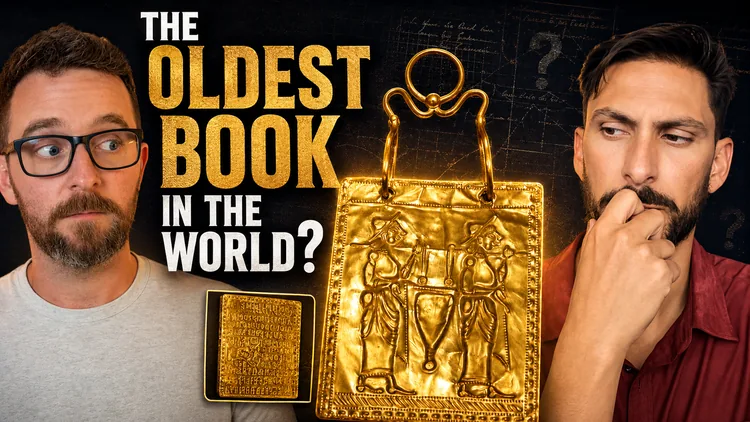
Six pages of beaten gold, and one enormous claim: the oldest book in the world. The Golden Orphic Book, a six-page Etruscan gold codex dated to 600 BC, is almost certainly a forgery, and the story of how it was sold to the public is a masterclass in how corrupt archaeology and the dead internet manufacture false history, one Facebook-sourced search result at a time. In this episode we do a complete forensic breakdown of the Golden Etruscan Book, and the reasons the Etruscan language cannot truly be translated. This episode will give you the tools to spot ancient artifact forgery, including a transliteration of the text in the Plus+ Extension.
 Plus+Full episode · 2h 8m
 InnerVerse Plus+
Hear the full 2h 8m episode
61 more minutes of this conversation, plus the complete Plus+ archive, premium video and a private podcast feed for your app.
Cancel any time.

Get tuned with Chance
Tuning forks find where energy is stuck in the field around your body and bring it back into flow. Sessions over Zoom, recorded for you to keep.
30 Minute Consultations
Have something to look at, or looking for guidance? We can consult oracular tools, read your chart, or just talk through whatever you choose.
In this episode
Core themes
Six Gold Pages, Huge Claim
The object at the center of this episode sits in the Bulgarian National Museum of History in Sofia: six leaves of what is claimed to be 23.82 karat gold, about five centimeters long, held together by gold rings, and dated to roughly 600 BC. Chance Garton keeps stressing the scale, since the whole thing is shorter than a golf tee and weighs around 100 grams. Dylan Saccoccio reads the letterforms as a mix, including a character that works like an Umbrian ph, which he would not expect that early, though regional variation across early Italian city states keeps him from calling it fake outright.
Where The Search Results Die
Type the artifact into Google and the summary calls it widely considered the oldest multi page bound book in the world. Chance clicks through to the sources and finds a post in a Facebook group called Archaeology and Civilizations, plus a journal item in the Brigham Young University Scholars Archive. Dylan notes that his own article, which he says is the only transliteration of the inscription made readable in Latin letters, does not appear in the first three pages of results. Both describe academic journals as gated, which is why they used AI to surface citations they could then verify.
Golden Plates And Borrowed Faith
The book is called Orphic because it resembles small gold afterlife leaves, the German totenpass, even though those are rolled into amulets and never bound, and Dylan says nothing in his transliteration points to Orpheus at all. The Brigham Young piece goes further, linking the find to Lehi leaving Jerusalem and to the plates Joseph Smith described. Chance calls this a perfect microcosm of scriptural stories being treated as the history that artifacts get judged against, and Dylan argues that Europe is constantly made to originate in the Orient to prop up those inherited fables.
The Director Who Kept Announcing
Nearly every public claim about the book traces back to one man, museum director Bozhidar Dimitrov, who presented it in 2003. Chance found that Vladimir Georgiev, named then as the translator, had died around 1986, some seventeen years before that announcement, and that the experts in Sofia and London who supposedly authenticated the find were never named or their methods documented. In 2010 Dimitrov told the press he had the bones of John the Baptist before any dating was done, which got him shunned by Sofia University and triggered an inquiry that surfaced an earlier career as a communist agent.
Cheap Gold, Priceless Headline
The story is that an anonymous 87 year old man found it in a tomb while working on a canal along the Struma River and handed it over decades later, leaving no dig site, sediment layer, or associated finds. No metallurgy has been published, not even basic X-ray fluorescence, and Chance says his emails to the museum in English and Bulgarian went unanswered. He prices the gold at roughly 1,100 dollars in 2003 against an Etruscan bronze that sold at Christie's for nearly 400,000, which is their answer to why anyone would forge in real gold.
Quotes
“I kind of approached it like a gambler and just seeing where the probabilities lined up before I make my bet.”
“In fact, it's neither widely considered to be the oldest book nor authentically dated to that century.”
“So, let me ask you something. What do experts in London and Sofia have to do with ancient Italian?”
“There is this need to make everything in Europe come from the Orient because there is a need to justify the historicity of the fables that have been given to the masses as history.”
“And Bozhidar Dimitrov, director of this museum, said that Vladimir Georgiev was working on a translation of the text. That guy had been dead for 17 years.”
“Etruscan cannot be translated. No matter how much somebody claims they can, no matter how much authority they claimed, and I will rest that on the work of Michael Grant.”
“He announced this before any dating had been done, but that's redundant, right? He might as well have announced that he found the bones of Santa Claus.”
“This Sofia National Museum in Bulgaria, I got a real bad feeling about you people. I think you're charlatans and I think you're a con artist.”
Dylan Saccoccio is the author of the Spirit Whirled series, The Real Universal Empire, and the Tale of Onora. After chasing language back as far as possible, he now explores other avenues to prove cultural diffusion of the ancient universal empire of priests, navigators, masons, and merchants. Find his latest of many hundreds of articles on Substack.
See all Dylan episodes→Kyle and Serena Denton are community herbalists creating wild-crafted and organic plant medicines out of Milwaukee since 2015. I have used their teas and tinctures on an almost daily basis for years now. Kyle is a great friend of InnerVerse and has appeared on the channel more times than I can count. These products work, not in the allopathic "pharma-medicine" way, but in a terrain-support, consciousness bolstering plant-teacher sort of way.