Moses and Jesus Share the Same Mother: Maris and the Astro-Theology of Exodus









Exodus hides a mother nobody names. Chance Garton and Dylan Saccoccio track Pharaoh's daughter through Jubilees and Josephus to the name Maris, sea-born like the Virgin Mary, then map the infant Moses onto the stars through a coin of Philip the Arab, a Renaissance painting read as a star chart, and the case that Noah himself never appears in any record before the Middle Ages.
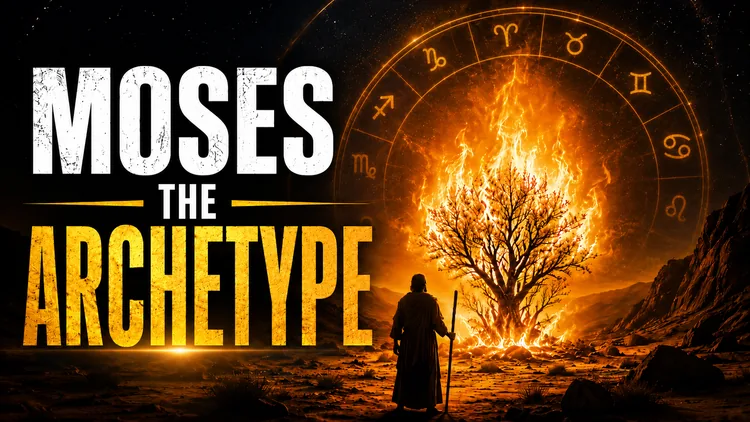
The second hour tackles the burning bush story, fire as a divine mediator and messenger, baptism and its analogs, Moses' identity as one of the Muses, and the ancient system of the astrological Naros Cycle and messianic incarnations.
 Plus+Full episode · 2h 24m
 InnerVerse Plus+
Hear the full 2h 24m episode
72 more minutes of this conversation, plus the complete Plus+ archive, premium video and a private podcast feed for your app.
Cancel any time.
Get tuned with Chance
Tuning forks find where energy is stuck in the field around your body and bring it back into flow. Sessions over Zoom, recorded for you to keep.
30 Minute Consultations
Have something to look at, or looking for guidance? We can consult oracular tools, read your chart, or just talk through whatever you choose.
In this episode
Core themes
Censored Early, Vindicated Late
Chance Garton opens the sixteenth Inner Whirled promising at least monthly episodes, then hands off to Dylan Saccoccio, who explains why the pair avoid current geopolitics after being censored almost a decade ago. Dylan recalls living in Brentwood near Andrew Breitbart, who dropped dead shortly after writing about John Podesta, and argues that the modern system rests on lies invented in the Middle Ages and passed off as ancient history. Citing Eusebius, the father of ecclesiastical history, he maintains that Israel was a Phoenician name for Kronos, time reckoned by the sun, and that the twelve tribes are the twelve signs, matching the twelve apostles and the twelve imams.
No Noah Before the Middle Ages
Dylan Saccoccio contends there is no Noah in the record before the Middle Ages, brushing aside the Gilgamesh epic as a text discovered only in the nineteenth century, written in a cuneiform style unmentioned before the seventeenth. He traces the word Semite, meaning a descendant of Noah's son Shem, to Eichhorn in the late 1700s, and notes the British aristocracy's parallel claim to the line of Japheth. Deucalion, he says, surfaces no earlier than the second century AD, while the oldest Greek account of Moses arrives at the end of the third, reversing the usual pattern of Greek mythological imperialism and suggesting Moses was built from the muses.
Coins, Arks and Doves
Working from an illustration in a book from the 1600s, Dylan Saccoccio presents a coin of Philip the Arab, emperor from roughly 244 to 249 AD, whose reverse shows four figures, two birds and an ark lettered NOE, with APAMEON below, which the eighteenth century historian Jacob Bryant read as ark. Chance Garton hears apa, father, joined to meon, the unformed being or pure potency. Dylan flags a suspicious IOVA on the obverse, ties Janus and Oannes to a Sicilian coin of the year, and reads Bryant's Analysis of Ancient Mythology on Theban colonies named for the ark, including a people said never to drown.
The Mother Named Maris
Exodus 2:5 leaves Pharaoh's daughter unnamed, but Chance Garton points out that the apocryphal book of Jubilees and the writings of Josephus call her Thermuthis, a name he links to the Egyptian cobra and fertility goddess Renenutet and to the Greek therm, heat, joined with metis, wisdom. Better still, Artapanus of Alexandria, an alleged Jewish historian of the second or third century BC known only through Eusebius and Clement, calls her Maris, as does the twelfth century Orthodox patriarch Michael the Syrian. Dylan Saccoccio adds that mar means sea in Latin, making Virgo Marina the virgin of the sea, so Moses, like Jesus, receives a Mary mother.
Renaissance Skies, Ancient Claims
Drawing on David Warner Mathisen's Starmyths of the World and the Robert Taylor material behind it, Chance Garton maps Romanelli's Finding of Moses onto the wide part of the Milky Way, casting Sagittarius as Moses's sister, Ophiuchus as Pharaoh's daughter, and Ara or Corona Australis as the basket. He reads the horned face as Aries leading the zodiac, the rejected golden bull as the passage out of Taurus, and the crystal river of Revelation 22:1 as the stream running down to Scorpio. Dylan Saccoccio counters that Ophiuchus was earlier called the toiler and that Fomenko dated Ptolemy's Almagest to the Middle Ages, making the whole tableau modern.
Quotes
“The 12 tribes are the 12 signs, the 12 months, just like the 12 apostles, just like the 12 patriarchs of Jacob, just like the 12 knights of the round table.”
“The chain of custody of ownership doesn't exist. The genealogy doesn't exist. None of it is real.”
“The old and new testaments are contemporaries of each other, both based on the older mythological systems and used in different parts of the world under the same priestly ruling class.”
“Judaism and Christianity are literally the same. It's not like one came from the other. It's like they are weird shadowy mirror reflections of each other.”
“It's the entirety of being unformed in a state of pure potential or potency that is then reformed by the father into the next world.”
“They're saying that this other guy said that Pharaoh's daughter who discovered Moses was named Maris.”
“The thread we're pulling might actually undo all astronomy of the known world, which is that it might all be a product of the modern era.”
“We either have a system that is modern forgery or these cultures were connected going back to the ancient past or everything's dated wrong.”
Dylan Saccoccio is the author of the Spirit Whirled series, The Real Universal Empire, and the Tale of Onora. After chasing language back as far as possible, he now explores other avenues to prove cultural diffusion of the ancient universal empire of priests, navigators, masons, and merchants. Find his latest of many hundreds of articles on Substack.
See all Dylan episodes→Kyle and Serena Denton are community herbalists creating wild-crafted and organic plant medicines out of Milwaukee since 2015. I have used their teas and tinctures on an almost daily basis for years now. Kyle is a great friend of InnerVerse and has appeared on the channel more times than I can count. These products work, not in the allopathic "pharma-medicine" way, but in a terrain-support, consciousness bolstering plant-teacher sort of way.