Tarot, Taurus, & The Secret Language of the Tower Builders









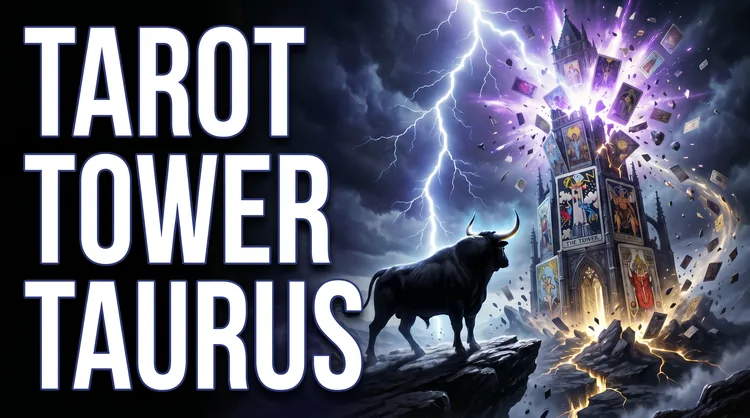
Taurus, the Tarot Tower card, Thor, Tours, and the Tyrrhenian Sea all share one ancient root. In Inner Whirled Episode 3, Chance Garton and Dylan Saccoccio trace the bull-Lord-Tower symbol back to a hidden Etruscan and Phoenician empire that left its fingerprints across Western language, mythology, and the tarot. This episode covers Etruscan and Celtic origins, the goddess Tanit and the tarot's High Priestess card, hornism and the protective meaning of bull horns, Apollo Granus and Kronos, Phoenician and Punic philology, Cornish and Welsh etymology, and astrotheology connecting the Pleiades, the dove, and the constellation Taurus.
This episode covers Etruscan and Celtic origins, the goddess Tanit and the tarot's High Priestess card, hornism and the protective meaning of bull horns, Apollo Granus and Kronos, Phoenician and Punic philology, Cornish and Welsh etymology, and astrotheology connecting the Pleiades, the dove, and the constellation Taurus.
 Plus+Full episode · 2h 2m
 InnerVerse Plus+
Hear the full 2h 2m episode
57 more minutes of this conversation, plus the complete Plus+ archive, premium video and a private podcast feed for your app.
Cancel any time.

Get tuned with Chance
Tuning forks find where energy is stuck in the field around your body and bring it back into flow. Sessions over Zoom, recorded for you to keep.
30 Minute Consultations
Have something to look at, or looking for guidance? We can consult oracular tools, read your chart, or just talk through whatever you choose.
In this episode
Core themes
The Tower, The Bull, The Tarot
Dylan Saccoccio builds the episode on a cluster of words he hears as one family: Welsh taru and Cornish taro for bull, Taurus the bull, the word for tower on the Marseille tarot card that he says is Italian rather than French, French Tours, Tyre, Thor, and Turms, the Etruscan Hermes. Ancient writers claimed the Tyrrhenians were named for the towers they built on high ground, which for him links Italy, Phoenicia and the Pelasgians. Chance Garton adds letter swaps that turn tor into Don the Lord, and both suggest the tarot itself may carry a bull and tower name.
The Sun's Hidden Monogram
A Cornish spelling of Jesu sends Dylan Saccoccio into the letters themselves. He reads the iota, an inverted H doing the work of a Greek eta, and a Latinized upsilon, and argues this is the monogram of Bacchus that later got read as the name of Jesus, sharing its first sounds with Jehovah. The three hash marks in the sun behind it he assigns to winter solstice, equinox and summer solstice, which is why Hermes is called thrice great. Chance Garton adds that if the letters hide Hu the god and esh the fire, then beings made in that image are hu-man.
Corn, Horn, and the Mural Crown
Chance Garton traces a chain through the consonants of corn, horn and crown to the radiance of the sun, the cornucopia and the spike of wheat held by Virgo. Philo of Byblos, quoting Sanchuniathon, says the Phoenician father of the gods, Dagon, takes his name from grain, and Chance pairs that with Granus, an epithet of Apollo, which with a G to K swap gives Kronos. Dylan Saccoccio calls it a career-best connection. He adds the mural crown of tower ramparts worn by Cybele, Rhea and Fortuna, while Chance offers the Irish cnoc, glossed as the hill of the sun.
Letters Before The Pictures
Both hosts reject the textbook order in which picture writing precedes the alphabet. Dylan Saccoccio notes that hieroglyphic spellings of names like Ptolemy and Alexander map neatly onto Greek and Latin letters, which he thinks only makes sense if letters came first and the pictures were a later layer of encoding, and he leans on Higgins to argue that Champollion's method can be bent to make anything mean anything. Chance Garton suspects writing began as a priestly secret that leaked to wealthy outsiders. Dylan points out that the Latin word for letters sits one letter from the Latin word for secret.
Tanit And The Priestess Card
The promised payoff is the High Priestess. Dylan Saccoccio sets the Phoenician goddess Tanit beside the card and matches her ankh-shaped cone body, bent arms, and headgear that he reads as crescent and ark at once, plus the tau cross of Terminus, god of boundaries. Chance Garton asks what a bow is called in Latin, and arcus, sitting next to arx for citadel, sends both men into delighted disbelief. Eros and his arrows follow, then Taweret, the hippopotamus goddess whose Greek name means water horse, the fish-tailed hippocamp, and Tanit spelled TNT, which Chance values at 650.
Quotes
“Inner Whirled Podcast episode 3. We got an exciting one for you. We are going to be into the piping hot fresh gravy with the excitement of new discovery.”
“I think we may be looking at the imprints of an ancient empire leaving its symbolism behind then getting adopted.”
“That is one of the biggest ones you've ever made. Like for me, that is like up there. That's like Michael Jordan level.”
“It's a cover story. That's why it covers the face of things.”
“The Welsh word for bull is taru and the Cornish word is taro. And that's where I was like, that's basically the tarot.”
“There's no such thing as a noun in nature. Like person, place or thing. That's what a noun is.”
“Things become invisible by their proximity. That's why it takes a lot of people looking together.”
“What is going on? We stumbled on this. We like kicked a beehive. It's a gravy portal.”
Dylan Saccoccio is the author of the Spirit Whirled series, The Real Universal Empire, and the Tale of Onora. After chasing language back as far as possible, he now explores other avenues to prove cultural diffusion of the ancient universal empire of priests, navigators, masons, and merchants. Find his latest of many hundreds of articles on Substack.
See all Dylan episodes→Kyle and Serena Denton are community herbalists creating wild-crafted and organic plant medicines out of Milwaukee since 2015. I have used their teas and tinctures on an almost daily basis for years now. Kyle is a great friend of InnerVerse and has appeared on the channel more times than I can count. These products work, not in the allopathic "pharma-medicine" way, but in a terrain-support, consciousness bolstering plant-teacher sort of way.