John Coleman | Rethinking Education With A Higher Perspective










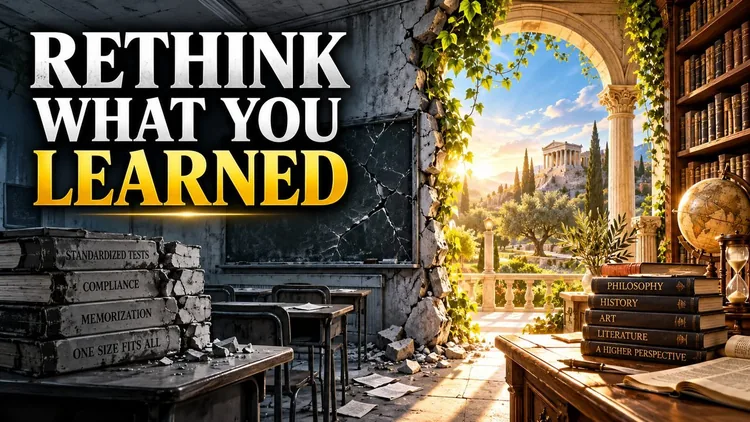
John Coleman is the host of his own Youtube channel and founder of Apocatastasis, An Institute for the Humanities. He recently had me on his channel to talk about the problems with modern education, and in this episode we are revisiting and expanding on ideas from last time.
 Plus+InnerVerse Plus+
 InnerVerse Plus+
Hear every full episode
Every extended episode, the complete Plus+ archive, premium video and a private podcast feed for your app.
Cancel any time.

Get tuned with Chance
Tuning forks find where energy is stuck in the field around your body and bring it back into flow. Sessions over Zoom, recorded for you to keep.
30 Minute Consultations
Have something to look at, or looking for guidance? We can consult oracular tools, read your chart, or just talk through whatever you choose.
In this episode
Core themes
Gatto and the factory model of schooling
John recaps John Taylor Gatto, a New York teacher of the year who gave a 1991 speech, left the classroom and spent his later years writing and lecturing against what he saw as a factory model of education. John places Gatto in a longer line of critics running from Maria Montessori and Rudolf Steiner to Ivan Illich and John Holt, and traces early homeschooling to a mix of sixties counterculture and evangelical Protestantism. His own twist is that private schools and homeschooling curricula share the same industrial DNA as public schools, so the critique should not stop at public education.
Listlessness, busyness and lost agency
Both men describe a schooling built on busyness and obedience for their own sake, which John says leaves former students unable to take agency, the habit of self-direction. John notes that the word course comes from the Latin for a racetrack, a circle that goes nowhere. Chance recalls reaching his early twenties with no working internal compass, cycling between work, class and video games that felt like more stimulus and reward. He contrasts that man-made clock of repeating cycles with what he calls real time, the passage marked by your own spiritual development.
Five kinds of wealth beyond money
John grounds his teaching in an expanded idea of wealth: spiritual, cultural, social, personal and commercial, with commerce kept in its place. Social wealth, he says, means knowing why a street is called Smith Lane, the families, poetry, architecture and food of a place, things he argues people have been deliberately stripped of. Chance answers that health is wealth and that real wealth is a garden, clean water and skills, while fiat money, in his view, is built on debt and buys products that end up as trash. He calls time the true currency, since energy flows where attention goes.
John's case for a healthier pedagogy
Asked what healthy pedagogy looks like, John argues deep learning starts with scholar-centered rather than student-centered learning, since teachers cannot give what they do not have. He questions how early formal schooling should begin, citing Thomas Hine's history of the American teenager for the view that compulsory high school also served the labor market. He asks for long-term bonds between scholars, students and subject matter, saying real intellectual growth often shows only after two or three years, and he calls trust the foundation. Chance adds his concern about separating young children from their parents so early.
From critique to action and further reading
John says the research community falls flat when it only consumes critiques instead of building something, and urges listeners to graduate into action in real life. He recommends Ivan Illich's Deschooling Society, which he says compares modern schooling to the automobile's effect on cities and imagined something like a chat room decades early, along with Horace Mann's writings, Anna Kamenetz and a fresh reading of John Dewey. Chance argues that nobody learns except autodidactically and that rites of passage are missing. John closes on Apocatastasis, a Greek word meaning restoration, and his work to preserve the classroom.
Quotes
“Sometimes people think private schools or homeschoolers get off the hook, but it's actually the exact same DNA model that comes from the industrial system, and it produces the same people.”
“It's supposed to feel good to be you and to be in your body, and you're not supposed to really need to achieve anything to feel good, because just being you is goodness itself.”
“Knowing the poetry of this particular part of the country, the architecture, the food: these things are like their own species. We've been denuded of these things, and deliberately so.”
“Your time is the real currency. Spiritual currency is attention, and energy flows where attention is directed in your life.”
“In terms of the perpetuation of knowledge, systemic knowledge, deep learning, I would suggest that it doesn't begin with student-centered learning. We hear that a lot, but I would say with scholar-centered learning.”
“It's not really just up to this one group called the government or to the teachers to be concerned with how people are being raised. It's actually everyone's concern.”
“If you go into one of these alternative schools or even one of the mainstream schools, you shouldn't be there if you don't trust the people.”
“Speaking of graduation, we need to make that graduation from just consuming the critique to actually acting on it in real life.”
Kyle and Serena Denton are community herbalists creating wild-crafted and organic plant medicines out of Milwaukee since 2015. I have used their teas and tinctures on an almost daily basis for years now. Kyle is a great friend of InnerVerse and has appeared on the channel more times than I can count. These products work, not in the allopathic "pharma-medicine" way, but in a terrain-support, consciousness bolstering plant-teacher sort of way.