Child Education at Home & Academic Freedom w/ John Coleman (Apocatastasis Institute)









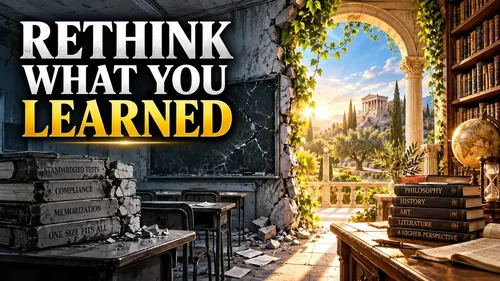
John Coleman of Apocatastasis Institute joins Vibe Rant to speak about the logos of learning, academic freedom, how best to guide the youth to be lifelong autodidactic philomaths, and what he's learned about the climate of state run education and homeschool ecosystems. Both parents and the eternally curious will find something to enjoy with the philosophy of pedagogy.
 Plus+InnerVerse Plus+
 InnerVerse Plus+
Hear every full episode
Every extended episode, the complete Plus+ archive, premium video and a private podcast feed for your app.
Cancel any time.

Get tuned with Chance
Tuning forks find where energy is stuck in the field around your body and bring it back into flow. Sessions over Zoom, recorded for you to keep.
30 Minute Consultations
Have something to look at, or looking for guidance? We can consult oracular tools, read your chart, or just talk through whatever you choose.
In this episode
Core themes
Restoration, Not Nostalgia
Coleman marks the tenth anniversary of the Apocatastasis Institute, the Connecticut college he founded and now staffs with other instructors: Dr. Fisher at its fearology center, Professor David Rios in the plastic arts, Adam Meers in mathematics, and Paula d'Angelus and David Roic at a new folk music and social change center. He explains that apocatastasis is a Greek word for restoration, carrying the connotation that what is put back returns higher than it was. Applied to schooling, he argues, that means keeping what is good in formal instruction and long academic journeys while repairing the rest, rather than setting the clock back to some golden age.
Socialization Is Work, Not a Service
Asked about the standard objection that a home educated child will have no social skills, Coleman argues the question itself carries a consumeristic ethos he traces to a shift around 1980, from the citizen of the liberal nation state to the consumer. Community is work, he repeats, and parents cannot farm socialization out to a public school, a private school or a homeschool co-op, because in his view all three run the same model. He points to Ivan Illich's Deschooling Society on the shelf behind him, and to Illich's parallel with the automobile, where added speed brought paved land, casualties and changed relations: quantity that never became quality.
Public Schools Make Public People
Coleman revisits an argument he credits to Clint Richardson, a past guest of Chance's, that the job of a public school is to make public people, with public read in its commercial, Black's Law Dictionary sense. On that reading, he contends, the school boards told everyone plainly what they were doing, and parental anger at a drained, drone-like teenager is misdirected. Gabe offers his own reading of the class bell as a Pavlovian cue to close your books, stop thinking and move into child traffic, and Coleman cites Carroll Quigley's Tragedy and Hope on how modern pedagogy convinces a share of students that books are not for them.
Trades, Application and the Empty Graduate
Answering a chat question on apprenticeship, Coleman says he finds it criminal that men and women are no longer given trades, praising Abbott Tech in Danbury and colleges that pull community work back in. He argues systematic book learning genuinely suits only a minority, and that a trade first lets a person come back to books at thirty or forty without being burned out. Chance describes finishing a degree in English and creative writing and feeling empty, a pure consumer who created nothing, until self taught design work gave him something tangible. Coleman cites a young woman with fifteen thousand hours of school who could not say what she liked.
Wonder, Symphony and What Intelligence Might Be
Gabe raises Howard Gardner's multiple intelligence theory and notes that Jordan Peterson waved it away as nothing more than multiple talents; Coleman answers that the idea is fine but could never be implemented, since in his view the masters of the system hold the choke points, as licensing did during covid. Pressed by Chance on whether intelligence is mutable rather than an innate IQ, Coleman offers three marks: a surviving spark of wonder, a symphonic sense of how subjects connect, and room for the spiritual questions he says Rockefeller pedagogy never asks. Chance adds Mark Passio's reading of intelligence as intellect plus generation.
Quotes
“Rather than sort of waiting for permission from authority and only learning what is by the book, through the officially sanctioned textbooks.”
“What we're trying to do is both address what I would see as errors of mainstream education, or factory learning, or Rockefeller learning, or however you want to phrase that.”
“I love that the word itself encourages you to research it. I love words that do that, that draw you into self-education.”
“You're not a consumer, you're not in this earth to be a consumer. If you want your child to be socialized, you need to be socialized.”
“The social skills that kids learn in school these days is how to be so immersed in a mass of sort of faceless crowd that they gain the skill of ignoring humans around them.”
“They were all little boys and girls once, and so if we can set that right, that's one way, a major way, to strike a blow against these criminal combinations.”
“Learning to recognize patterns, teaching patterns of how life is structured, that is something that increases intelligence, because you know what you're looking at when you see it.”
“What's most important is that there is the presence of knowledge, that the parents are living a life of knowledge, however that is lived in the house.”
“I think that is the essence of masculinity. It's like, oh, you think you did something good, well don't put that fire away, we're going to give you extra work while you're high on yourself.”
“You have 15,000 hours of school and you don't know what you like at the end of it. Well, there's a pity there, there's a poverty there.”
“Intelligence is intellect plus generative, or gens. So it's the left and the right brain in unison, in harmony, something that's not accounted for in most models of education.”
“When you're done with the debate the two people are still friends, nobody lost anything, because it was about the ideas and not the person.”
Kyle and Serena Denton are community herbalists creating wild-crafted and organic plant medicines out of Milwaukee since 2015. I have used their teas and tinctures on an almost daily basis for years now. Kyle is a great friend of InnerVerse and has appeared on the channel more times than I can count. These products work, not in the allopathic "pharma-medicine" way, but in a terrain-support, consciousness bolstering plant-teacher sort of way.