The Devil is in The Data | Chance Garton on King Hero's Journey with Beth Martens









Beth Martens had me back on King Hero's Journey for the third time, and we took on big data as a system of control. We watched a leaked Google video, Beth read James Corbett, and I read up on Palantir and waved around a weighted tuning fork. It ran two hours, and the counting segment at the end is a fun one.
 Plus+InnerVerse Plus+
 InnerVerse Plus+
Hear every full episode
Every extended episode, the complete Plus+ archive, premium video and a private podcast feed for your app.
Cancel any time.
Get tuned with Chance
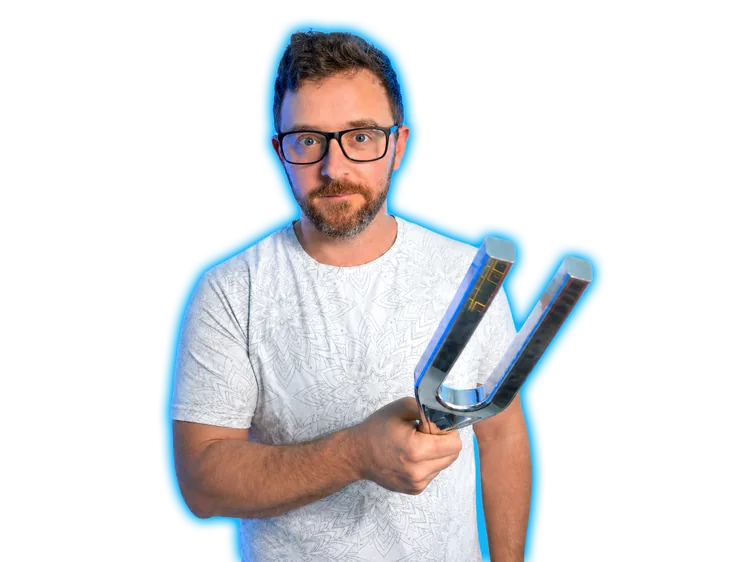
Tuning forks find where energy is stuck in the field around your body and bring it back into flow. Sessions over Zoom, recorded for you to keep.
30 Minute Consultations
Have something to look at, or looking for guidance? We can consult oracular tools, read your chart, or just talk through whatever you choose.
In this episode
Core themes
Why data is the devil's tool here
Beth opened with Art Zimmerman's line that God knows everything and the devil wants to know everything, and asked why the beast is so hungry for our data. Chance said that in individual experience the tension between good and evil teaches us what is right, but that big tech uses data differently, as control. He argued that data-driven decisions would train people out of deciding for themselves while leaving them convinced the choices were their own. He tied it to his earlier appearances on Gnosticism and simulation theory.
Numbers, samples and shaky statistics
Asked what birthed the data beast, Chance pointed to the moment numbers lost their spiritual meaning and became abstract integers, which he called a Luciferian fall that lets people be seen as statistics. He questioned how a sample of 300 can speak for 350 million people and described the replication crisis in published studies. He argued that studies often begin with a conclusion, create an illusion of causality, and that larger data harvesting only gives the harvesters sharper predictions. Beth added the point about studies built to prove what is already assumed.
Cybernetics and closed feedback loops
Beth read James Corbett's 2017 editorial Big Data Exposed, which covered psychographic profiling, Cambridge Analytica and the marionette image from Pinocchio. Chance then explained cybernetics, learned from Wayne McRoy Jr, as systems control over living things and machines alike. He contrasted the body's distributed feedback loops with closed loops such as addiction, and said social media memes and single-source communities work the same way. He showed a weighted tuning fork on reflexology points as an example of using an internal loop in a positive way.
The leaked Google video and the barcode
Beth played a leaked internal Google video that described user data as a ledger in the Lamarckian sense, passed across generations and used to nudge behavior toward chosen goals. Chance said it showed that the corporate world plans generations ahead while the public debates smartphones. He questioned genetics as a mechanistic code and linked DNA to the twin serpents of the caduceus. He then pulled up the International Barcode of Life website, noting its serpent logo and its stated aim to illuminate biodiversity, and argued that life cannot be catalogued by dissection.
Middlemen, containers and counting
Chance argued that the devil figure in these systems is the middleman, linking Mercury, the messenger of the gods, to commerce, banking and the Hermes name he noticed in PayPal's web addresses. He said attention is spiritual currency and recommended building one's own containers such as a website. He read about Palantir and Pegasus spyware, then discussed counting. He said numbers are abstractions, resources are really source, and keeping score in relationships turns them into a game. Beth responded with her thoughts on accountants and the Count Dracula image.
Quotes
“I want to credit first, Mr. Art Zimmerman for saying this phrase that it's been my head ever since that God knows everything and the devil wants to know everything.”
“Why is that beast so hungry for our data? Why are people very blind to it out there when they talk about, oh, well, I've got nothing to hide, take all my data.”
“I think it goes back to maybe the point where numbers quit having a spiritual connotation or a correlation to other aspects of life and became just this abstract integer way of looking at numbers. That's kind of like the Luciferian fall, in a sense, because now we can just look at human beings as a statistic.”
“The larger definition is basically systems control over everything, living and machine. And so the living things influence the machines and the machines influence the living things, but the point is that living things are in that definition. And it's about controlling them.”
“How I see randomness is like the shadow of synchronicity, right? Because that's the thing that the big data can't ever get a handle on is our ability to move through synchronicity to follow divine breadcrumbs that are invisible, that can't be seen, that are based in divine order.”
“That is exactly what scientific materialism is all about, taking life and chopping it up into unliving parts and then trying to figure out how it all works when it's no longer a holistic living thing.”
“Your brain isn't in the matrix or your mind isn't in the matrix. Your mind is a matrix, which is a womb. That's what the word matrix means.”
“Energy flows where attention is directed, right? So it goes back to that idea of a container. If all your energy is directed towards Netflix, where does that go?”
“Numbers are a fictional conception in our mind. They're an abstraction. Technically, there's not one of anything. There's not three of anything. There's not nine of anything.”
“Let's not keep score with each other. Let's give whenever our cup is full enough to give. Let's hold whenever we need it for ourselves and let's trust in the flow of the universe.”
Beth Martens is a legal empowerment advocate and author focused on personal freedom, resistance to health mandates, and archetype-based purpose coaching through her House of Free Will Ministry.
See all Beth episodes→Kyle and Serena Denton are community herbalists creating wild-crafted and organic plant medicines out of Milwaukee since 2015. I have used their teas and tinctures on an almost daily basis for years now. Kyle is a great friend of InnerVerse and has appeared on the channel more times than I can count. These products work, not in the allopathic "pharma-medicine" way, but in a terrain-support, consciousness bolstering plant-teacher sort of way.