Moon Knight Ultra Dims The Light of Egypt (Pt 1) | Marvelous Demystifiers Episode 5









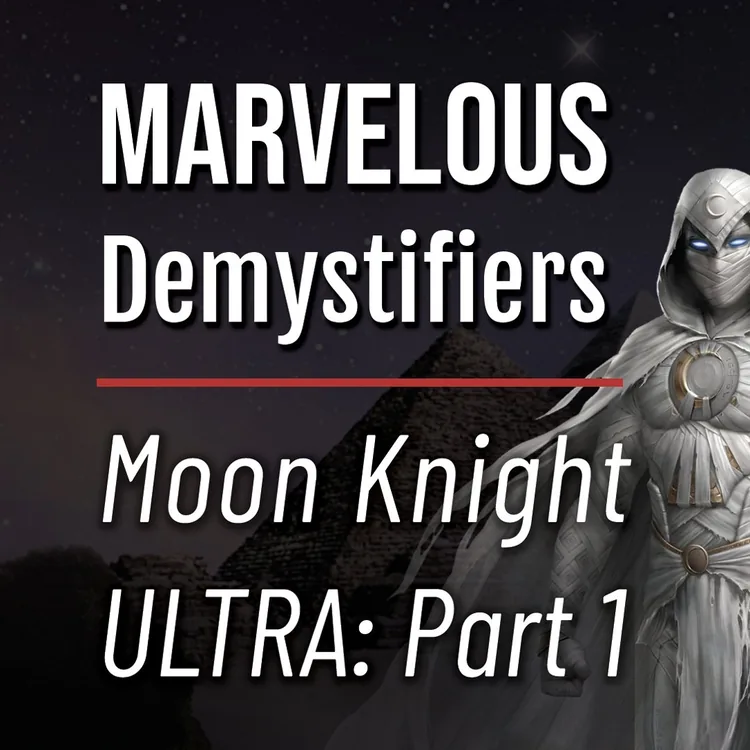
This month's deconstruction of Disney-Marvel mind control is going to be a doozy. The gang has been just itching to get back together to analyze the new 6 episode Disney+ series, Moon Knight, and in this video we'll tackle the first episode. The returning overarching theme is Disassociative Identity Disorder and the MK Ultra of it all, but we'll also do our best to demonstrate the distortion of public perception regarding ancient Egyptian culture.
 Plus+InnerVerse Plus+
 InnerVerse Plus+
Hear every full episode
Every extended episode, the complete Plus+ archive, premium video and a private podcast feed for your app.
Cancel any time.
Get tuned with Chance
Tuning forks find where energy is stuck in the field around your body and bring it back into flow. Sessions over Zoom, recorded for you to keep.
30 Minute Consultations
Have something to look at, or looking for guidance? We can consult oracular tools, read your chart, or just talk through whatever you choose.
In this episode
Core themes
The opening ritual as birth initiation
The hosts joke that they spent forty-five minutes on the two-minute opening, where Harrow pours water, rings his glass, smashes it and walks out on the shards in his sandals. Chance reads the walking stick as the hieroglyph that opens a story and as a flagellation tool, while Gabe sees the cloth laid on the table as a placenta and the cane and bowl as Cain and Abel. The broken bracelets are read as shackles of service, and the crocodile-headed Libra scale tattoo marks Harrow as the adversary.
Shu, sandals and the straw man
Chance argues the sandals sit at the center of the whole conspiracy cork board. Egyptian figures are usually shown barefoot and sandals were often papyrus, so he sees the straw man who lives on paper standing between the sole and the earth. Shu, whom Chance describes as separating sky and earth and bringing pain into the world, explains the glass in the shoes, and the ankh doubling as a sandal strap ties Steven's chained ankle to the theme. Gabe adds Deuteronomy 11:24, every place the sole of your foot treads, and Steven's habit of saying laters gators.
Public persona versus private self
Gabe opens with Denkraumverlust, the loss of thinking space when the art outranks its subject, and applies it to the driver's license as a second persona carried in the wallet. The hosts read Steven Grant as the public mask and Mark Spector as the private self, noting that Harrow's scales cannot judge him because of the chaos within. Gabe calls the magical costume one of entertainment's biggest lies and says the human ability to lie opens parallel dimensions, while Chance answers that there is one indivisible ether and the real split happens within ourselves.
Ammit, Khonshu and a feminine sun
Chance's reading is that the show encodes a feminine sun and a masculine moon, pointing to the scarab as Ammit's sun symbol and to Harrow's victims drained like bodies left out in the sun. He frames Ammit judging people before they do wrong as predictive programming, and the hosts contrast the crocodile with Khonshu's falcon head. Chance also says Khonsu was long translated as the king's placenta, now layered with a newer reading of going back and forth, which Gabe ties to boustrophedon writing and the palindromic Belphegor's prime.
Seven gods or nine in the Ennead
Steven's complaint that a museum poster shows only seven gods opens a long question about the septenary and the Ennead. Chance notes that Hathor, a cow goddess, appears on the poster though she was not one of the original nine, and wonders whether the two missing forces are hidden chakras in the ankles and knees. Gabe connects Hathor to Belphegor's prime, the number 216 and tax day before Taurus season, and the hosts find the rift between gods and men echoed in a book page saying the Egyptians originally revered one hidden god.
Quotes
“Denkraumverlust, and that means loss of thinking space, and it is used in the artistic world to describe confusing the object for the subject.”
“The hieroglyph is a sound or a set of sounds, often multiple consonants represented by one hieroglyph, but you don't know the vowels that go between them.”
“People identifying themselves with their driver's license, with their state issued identification, this second persona that everybody's expected to take care of like a little baby, like a little homunculus living in your wallet.”
“Your heart gets heavy whenever you are not true to yourself. It has nothing to do with per se feeling good or feeling bad or being the good guy or being the bad guy.”
“In Egypt also the sandals were often made of papyrus rather than leather, so are we starting to see the picture here of the straw man who lives on paper?”
“Humans' ability to lie gives us the ability to open parallel dimensions, and a lot of people are living very deep in the maze of this hall of mirrors of lies and fiction.”
“Shu comes in and splits the land and the sky, creating the space in which human beings can exist by creating a space in between, the firmament separating the waters above from the waters below.”
“Can you see ether? No. Is it always present everywhere? Yes. It's the hidden one and it's the interconnectivity and communication of all things.”
“Here we are talking about the great divide, the splitting of the mind and the turning us into a two headed monster with a false persona attached to us.”
“I think that it's a feminine sun and masculine moon in this depiction, which is opposite to what Western occultism and magical systems believe.”
“One of the biggest lies is that some kind of costume, some kind of a ritualistic garment, is going to give you abilities or the ability to fly or the right to kill a man.”
“Everything is here now and here and now is all that there is, but we're the ones that split, we're the ones that become parallel universes within ourself that get into conflict.”
Gabriel, known on air as Slick Dissident, co-hosts InnerVerse's Vibe Rant show and is a longtime recurring guest on the podcast. He teaches occult symbolism and tarot on his YouTube channel, ranging across the Major Arcana, the esoteric Enneagram, mythology and archetype, mystic linguistics, and the symbolism hidden in popular film. He is best known for Tarot-tories, his own system mapping the 22 Major Arcana and zodiac archetypes onto the geography of the United States.
See all Gabe episodes→Kyle and Serena Denton are community herbalists creating wild-crafted and organic plant medicines out of Milwaukee since 2015. I have used their teas and tinctures on an almost daily basis for years now. Kyle is a great friend of InnerVerse and has appeared on the channel more times than I can count. These products work, not in the allopathic "pharma-medicine" way, but in a terrain-support, consciousness bolstering plant-teacher sort of way.