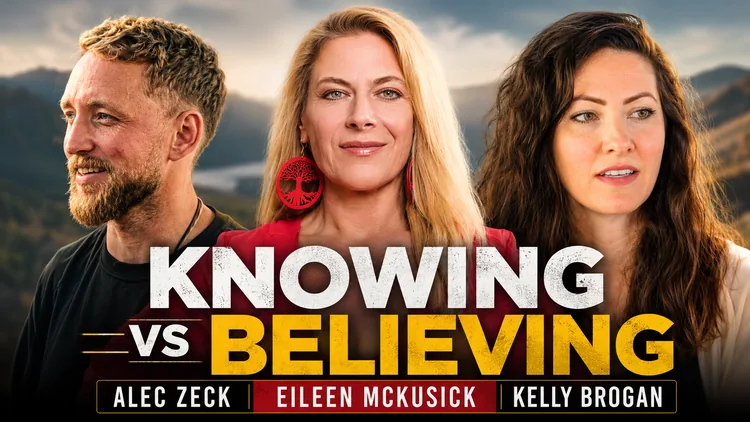
Kelly Brogan, Alec Zeck & Eileen McKusick: Knowing vs Believing | Live at Music and Sky









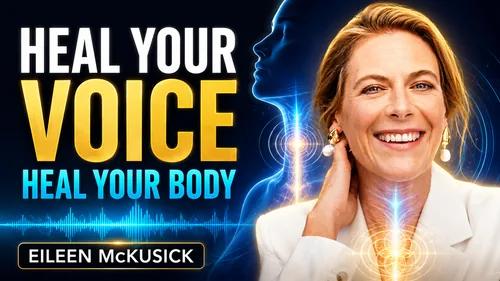
Recorded live at the Music and Sky 2022 festival campfire, this roundtable brings together four people who rarely share the same screen: psychiatrist and author Kelly Brogan, health freedom advocate Alec Zeck, biofield tuning pioneer Eileen McKusick, and Chance Garton of InnerVerse.
Topics: why nature may not repeat itself the same way twice and what that means for every fixed framework we rely on; the difference between knowing and believing and why claiming certainty turns inquiry into idolatry; language as the original metaverse, how the overlay of words and belief creates a hyperreality that makes nature itself feel fake; the imposter syndrome trap in healing work and why the solution is simply not being an imposter; why this generation is the karmic cleanup crew doing the heaviest lifting in the great pattern-shift; Chronos time vs real spiritual time and why a year spent doing the same thing feels like it vanishes; and each panelist's personal takeaway from the weekend.
 Plus+InnerVerse Plus+
 InnerVerse Plus+
Hear every full episode
Every extended episode, the complete Plus+ archive, premium video and a private podcast feed for your app.
Cancel any time.
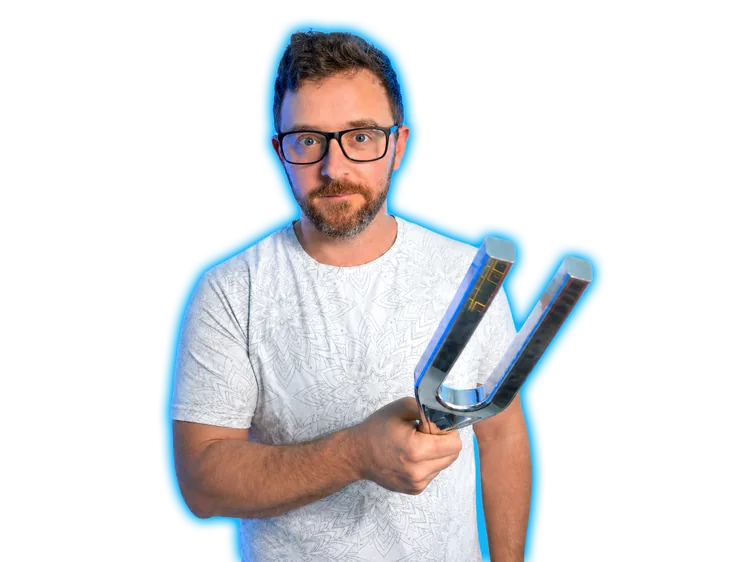
Get tuned with Chance
Tuning forks find where energy is stuck in the field around your body and bring it back into flow. Sessions over Zoom, recorded for you to keep.
30 Minute Consultations
Have something to look at, or looking for guidance? We can consult oracular tools, read your chart, or just talk through whatever you choose.
In this episode
Core themes
Questioning the cycles we live by
Chance opens the panel by asking whether nature ever does the same thing the same way twice, questioning scales of seven or twelve notes, twelve zodiac signs, neat story arcs and even the 365.25 day year. Eileen McKusick answers with the sound healing time warp and a story she heard about the discovery of pi and phi, and says she is learning to question everything. Kelly Brogan, citing Charles Eisenstein, suggests reality itself may be evolving, and Chance says early Egyptians kept several calendars at once. Answering an audience question later, Chance contrasts repetitive Chronos time with the felt time of real learning and growth.
Knowing versus believing
Alec Zeck returns to the talk he gave earlier in the weekend on the difference between what we know and what we believe. He argues that people who dissolve one official certainty often install another, attach their identity to it and defend it to the death, and that claims of objective truth lead to dogma. His alternative is to identify with the process of exploration itself, which he says makes not knowing comforting rather than scary. The conversation extends this into dogma as idolatry, with idle meaning not moving, and questions as a branching pattern, while Eileen McKusick says the beliefs we cling to stop questioning altogether.
Language, maps and making it up
Chance draws on Baudrillard's Simulacra and Simulation to describe hyperreality, arguing that language works as an overlay, perhaps the original metaverse, that can make nature itself feel fake. He tells energy workers facing imposter syndrome that making it up as you go, with good intentions, aligns you with the creative intelligence of the cosmos. He credits Eileen McKusick for admitting her biofield anatomy hypothesis could be imaginary, calling it a language the body can speak. Eileen says the map grew out of years of client sessions, that she doubted it for a long time, and that in her view it works whether or not she made it up.
Being wrong, shame and choosing life
Kelly Brogan asks what it would take to stop expressing our vital force through the need to be right, describing what she calls putting on the villain crown, a nervous system level ability to tolerate being seen as bad and wrong, which she says is needed before we can discern rather than judge and blame. Drawing on Alexander Lowen's book Fear of Life and on family constellation work, she frames I choose life as a radical act of defiance. Chance answers with comedian Owen Benjamin's line I might be wrong, but I'm not lying, arguing that few phrases are more powerful than I was wrong.
Victimhood, consent and trauma as catalyst
The panel questions the old they did it to us story, arguing that society is built from the bottom up and that would be controllers depend on consent. Alec Zeck pushes back, asking how anyone can know with certainty that belief creates every experience, and cites the Law of One's idea that trauma is a catalyst, calling the last two and a half years a godsend for his own authenticity. Eileen McKusick describes what she calls a posture of victimhood in the biofield anatomy, and says realigning her posture changed how she saw a hard conversation.
Quotes
“What I'm learning to do is to question every single thing, and how what we're told creates an overlay that stops us from seeing what's really there.”
“At this point, every time I find out that what I thought was true is not, like every deception that's exposed is like delightful to me. It becomes funny.”
“We need to surrender to reality. And then there's the opposite end of the spectrum, that reality is self-directed, that we are co-creating it.”
“Making it up as you go does not make you a fake. It actually aligns you with source, with creator, with great spirit.”
“Regardless of whether it's real or not, it showed me that our bodies are inside our minds and not the other way around like we've been told.”
“How do we get to this place where we can choose and discern instead of judging, blaming, shaming, and condemning?”
“There's very few things more powerful, few phrases more powerful than I was wrong, because the next thing that happens is you get to correct.”
“When we claim objective truth on something, I think we need to be very careful because that leads to dogma, that leads to identifying with it.”
“We cling more tightly to our beliefs than we do to anything. And yet, what they do is they stop the questioning.”
“What it is to choose life is such an act of defiance, and it also requires that you be willing to look at the shame around your own animating energy.”
“I think a lot of people want to know so badly and want to assert that they know something to be true because they're afraid to not know.”
“Real time is not measured even in seconds or the movements of luminaries, it's really not measured at all, but it's felt and experienced in the change and flow of us.”
Dr. Kelly Brogan is a holistic psychiatrist and New York Times bestselling author known for her root-cause approach to mental health and her Vital Mind Reset program; she appeared on InnerVerse as part of a fireside panel discussion with Alec Zeck and Eileen McKusick at the 2022 Music and Sky gathering.
See all Kelly episodes→Kyle and Serena Denton are community herbalists creating wild-crafted and organic plant medicines out of Milwaukee since 2015. I have used their teas and tinctures on an almost daily basis for years now. Kyle is a great friend of InnerVerse and has appeared on the channel more times than I can count. These products work, not in the allopathic "pharma-medicine" way, but in a terrain-support, consciousness bolstering plant-teacher sort of way.