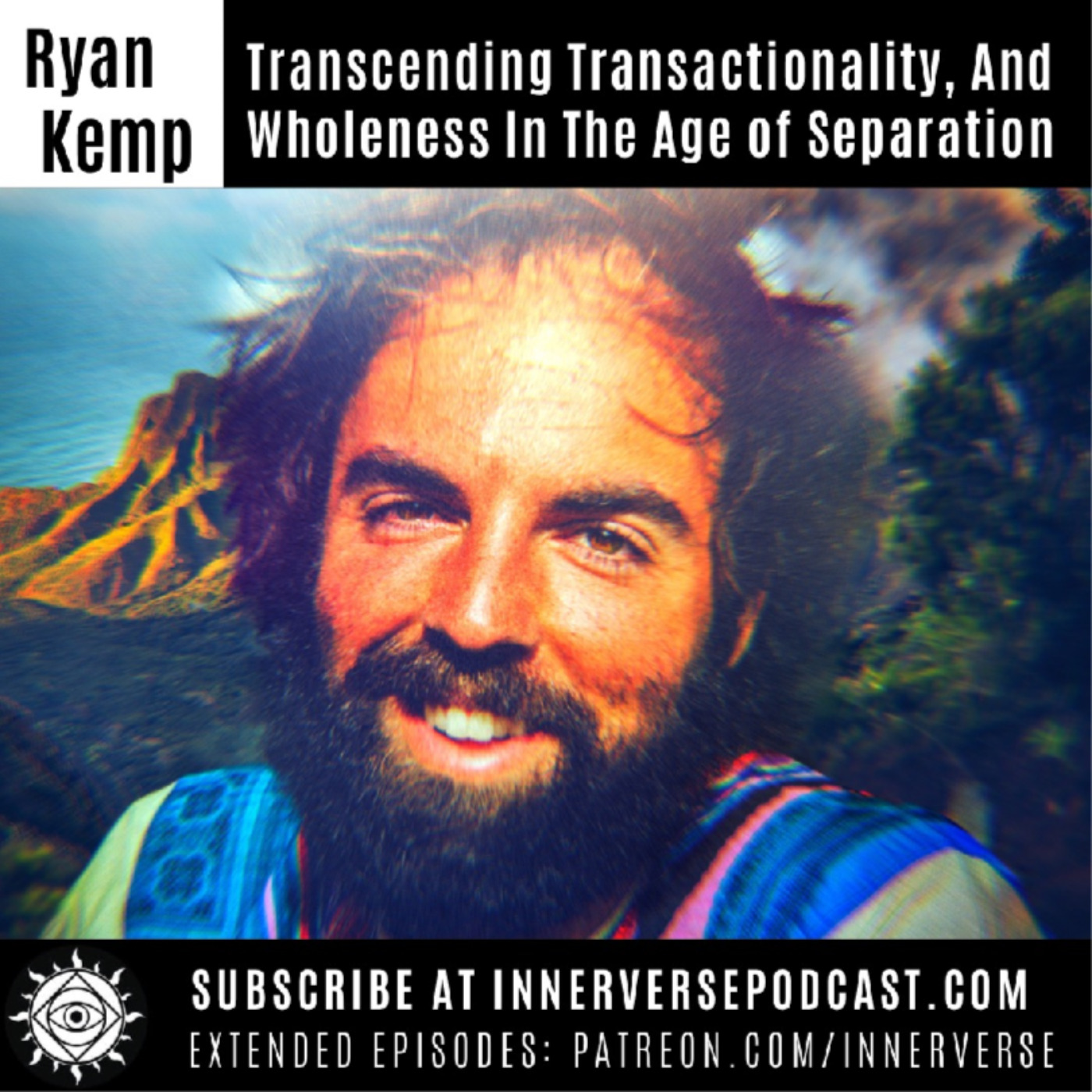
Ryan Kemp | Transcending Transactionality, and Wholeness In The Age of Separation









Ryan Kemp is the author of The Age of Separation, a text that combines aspects of Buddhism, yogic philosophy, Ayurveda, indigenous wisdom, psychedelic experiences and more. In this conversation we discuss ideas from his book with the InnerVerse perspective.
 Plus+Full episode · 2h 34m
 InnerVerse Plus+
Hear the full 2h 34m episode
71 more minutes of this conversation, plus the complete Plus+ archive, premium video and a private podcast feed for your app.
Cancel any time.

Get tuned with Chance
Tuning forks find where energy is stuck in the field around your body and bring it back into flow. Sessions over Zoom, recorded for you to keep.
30 Minute Consultations
Have something to look at, or looking for guidance? We can consult oracular tools, read your chart, or just talk through whatever you choose.
In this episode
Core themes
Accumulation, Ayurveda and Society as One Body
Chance frames Ryan Kemp's book The Age of Separation as an Ayurvedic reading of accumulation applied to society as one larger organism, where ideas and identifications can build up and cause disease much as material accumulation does. Ryan says Ayurveda names the first stage of disease sanchaya, and that studying it in Kerala showed him where Ayurveda and yoga intertwine. His argument is that whatever a person takes in, from beliefs to knowledge, needs a matching output free of righteousness, or it leads to disequilibrium. Chance suggests breath and movement practices build a healthy pranic accumulation, while Ryan replies that prana flows through the chakras rather than stacking up.
Calcified Belief and the Hunger for Identity
Ryan describes belief as information that should stay fluid, and says that once it calcifies into a collective identity it breeds judgment and violence, a point he credits to Krishnamurti. Chance reads passages from the book on consuming ideologies and fandoms, and both men tie that habit to shrinking attention, with Chance admitting the tug of his phone at a red light. Ryan answers with the self-inquiry of Ramana Maharshi, asking who you are without your phone and your digital identity, and with the Vipassana view that no one of the body's changing particles is the I.
Priceless, Not Worthless: Beyond Transactionality
The conversation treats transactionality as the illusion that every exchange must be equal in value. Chance points to indigenous customs where returning an equivalent gift reads as a rejection, and prefers the word permeable to vulnerable because a permeable person lets feelings pass through. He argues that unpaid labor and a few conscious breaths are priceless rather than worthless, and that close relationships need no scorecard. Ryan adds that a gift is not a gift while you cling to reciprocity, that we expect gifts in a certain form, and that hardship can arrive as one, citing Ram Dass on suffering as grace.
Babylon, Confusion and the Middle Way
Chance and Ryan agree that craving the marketplace and fleeing it both keep a person tethered to it, and that the middle way is to use the value system without getting caught in it. Ryan says an Aramaic scholar told him the name Babylon comes from a word meaning to confuse, and points to cobalt mined for computers as a sign that every choice steps on someone. Chance links Babylon to the Tower of Babel and argues that Latin and legalese work as calcified control languages. Both then contrast co-destruction with co-creation, with Ryan citing Charles Eisenstein.
Pedestals, Personas and Nonverbal Liturgy
Chance argues that neither oneself nor a teacher belongs on a pedestal, since that arrangement is where separation enters, and he observes that the appearance of knowledge gets monetized through the right look and follower counts. Ryan replies that trendy concepts invite a superficial first pass, which still counts as part of the path, and that spirituality is a demolition project rather than a tally of credentials, so the less a person clings to, the more power and worth he says they hold. Chance allows that outfits can signal without becoming identity, and Ryan likens clothing to liturgy, a nonverbal invitation toward harmony rather than manipulation.
Quotes
“The more that we get caught in the quantifiable realm, the less we can actually dip into the qualitative aspects of life.”
“The funny thing about being is you're already doing. Being is a verb right there.”
“I think that presence is emptiness. And I think that gratitude is emptiness because within that emptiness you're being filled.”
“If you're vulnerable, then you can be hurt. And if you're hurt, then that's something that needs healed. But if you're permeable, the thing comes through and passes through.”
“If it's really a gift, you just give it. It's not a gift if you're clinging to reciprocity.”
“We can't put ourselves on the pedestal of being the one that's got it all right. But we also can't put someone that we're looking at as a teacher on a pedestal.”
“Spirituality is a deconstruction process, it's a demolition project.”
“Nothingness is important because it's the power to forget also. And I think that there's times where forgetting is necessary for our journey.”
Kyle and Serena Denton are community herbalists creating wild-crafted and organic plant medicines out of Milwaukee since 2015. I have used their teas and tinctures on an almost daily basis for years now. Kyle is a great friend of InnerVerse and has appeared on the channel more times than I can count. These products work, not in the allopathic "pharma-medicine" way, but in a terrain-support, consciousness bolstering plant-teacher sort of way.