David Mathisen | Star Myths of the Norse: Thor, the Universal Thunderer, & the Holy World Tree









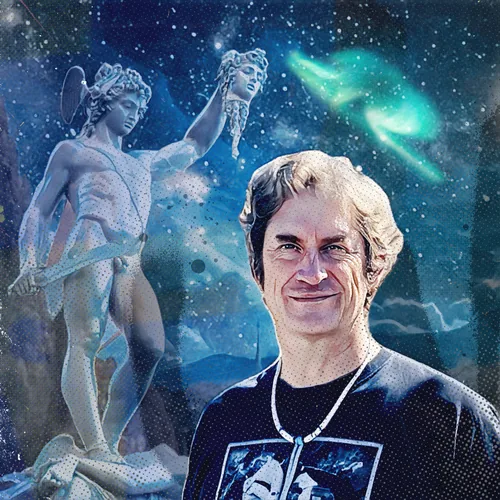
David Warner Mathisen returns to InnerVerse to pick up where we left off two weeks ago, and take a deeper look at the universal star myths from whence we receive the legends of Yggdrasil, and the mightiest Asgardian thunder god, Thor. There will surely be more in store beyond these topics, so tune in and edify your mind!
 Plus+InnerVerse Plus+
 InnerVerse Plus+
Hear every full episode
Every extended episode, the complete Plus+ archive, premium video and a private podcast feed for your app.
Cancel any time.

Get tuned with Chance
Tuning forks find where energy is stuck in the field around your body and bring it back into flow. Sessions over Zoom, recorded for you to keep.
30 Minute Consultations
Have something to look at, or looking for guidance? We can consult oracular tools, read your chart, or just talk through whatever you choose.
In this episode
Core themes
A system older than the ancient world
David Mathisen argues that ancient Egypt, Sumer, India, China and cultures across Africa, the Americas and the Pacific are all working from one celestial system, which means the source has to be older than any of them. He calls that source the deep ancient, separated from recorded history by a cataclysm around thirteen thousand years ago, the event pointed to by Comet Research Group work on the Younger Dryas. His 2019 book Ancient Worldwide System traces the same star patterns through Indian, Egyptian and Mesopotamian myth. The ancients inherited the system, he says, but probably no longer fully understood it.
Thor is the constellation Hercules
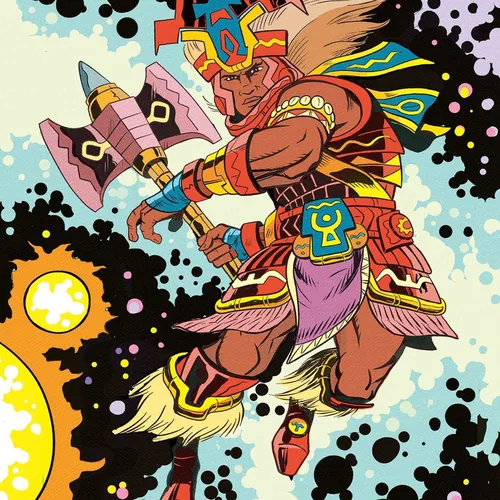
The core demonstration of the episode is that Thor is the constellation Hercules as outlined by H.A. Rey in The Stars, A New Way to See Them. Mathisen points to the same signature every time, a weapon brandished overhead, the other arm outstretched, a deep lunge with the rear heel raised, and the square keystone head that becomes a full beard. Four faint stars above that head form the axe or hammer, and one extra star shortens the handle, matching the Edda story where Loki, disguised as a fly, spoils the dwarf Brokkr's work.
The same thunderer in every language
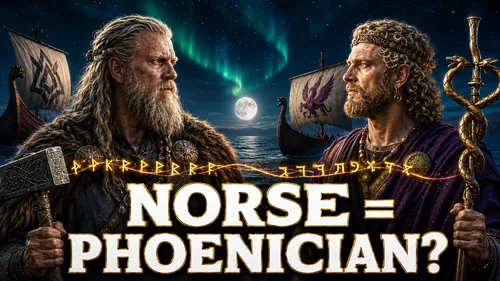
Once the outline is fixed, Mathisen and Chance Garton run it around the world. Zeus appears in that exact lunge on a Greek vase in Munich, fighting Typhon, who is Ophiuchus. Shango of the Yoruba carries an axe, Chaac of the Maya takes the pose on an eighth century cup in the Met, and Indra plays the same part in India. Garton adds Sancus of the Umbrians, whom the Greeks equated with Hercules, plus Taranis of the Britons and the Phoenician word for thunder. Tacitus and Herodotus, they note, already treated these gods as equivalents.
Literalism as a second catastrophe
Mathisen treats literalist religion as a deliberate takeover rather than an innocent misreading, the argument of his books The Undying Stars and Myth and Trauma. He cites Michael Hudson on Hammurabi and the debt jubilees the ancient world practiced, and says the destruction of the old system is what made feudalism and oligarchy possible. Garton reads Synesius of Alexandria admitting he will preach fables in public and stay a philosopher in private. Robert Taylor, an English minister who laid all this out in the 1820s, spent three years in jail for it.
Ophiuchus, the world tree and the cure for trauma
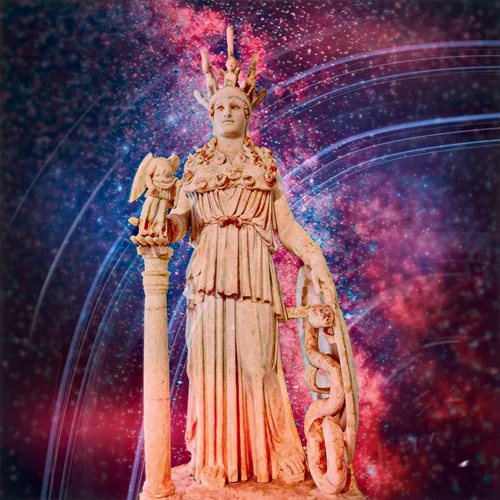
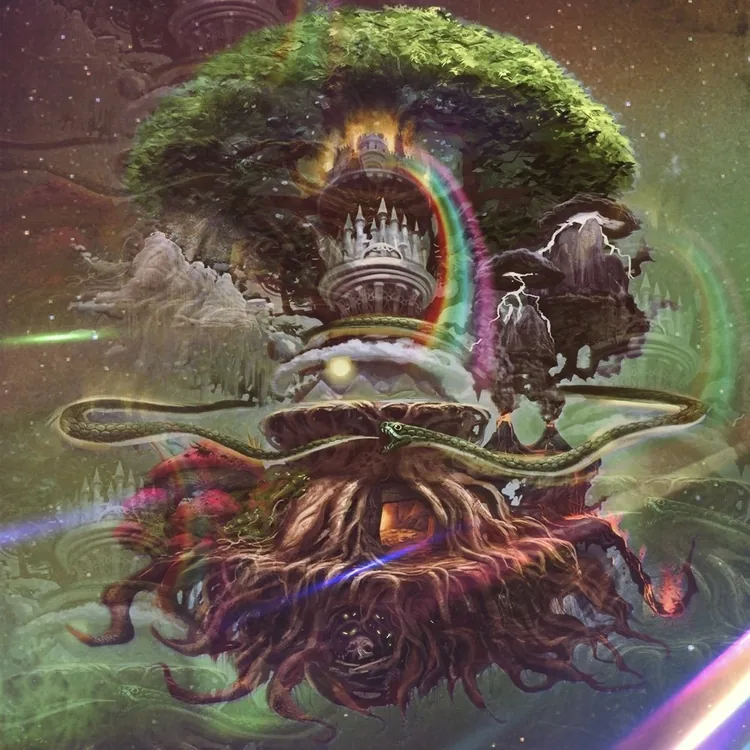
The second half turns to Ophiuchus, the constellation just below Hercules, which Mathisen reads as the mountain, the tombstone, the tablets of the law, the Shiva lingam, and the spear bearer behind Odin, Moses, Athena and Solomon. Redraw Hercules as a whirling disk and it becomes a scraggly tree standing on that mountain, which is Yggdrasil, the fig tree Odysseus clings to, the rowan that saves Thor. The point, he insists, is practical. The myths exist to heal trauma in individuals and societies, and symbolic literacy is psychic self defense.
Quotes
“I think that's the more likely explanation is there is something more ancient than ancient Egypt, something more ancient than ancient Sumer, something more ancient than ancient China, ancient India, where these all came from and potentially you know, took on different forms over the millennia.”
“So, you know, this is privatized wisdom in a way, which is the ultimate natural resource, because you could give somebody all of the physical resources in the world, but they can't take that with them.”
“So who is Job? That's Jove. So like what the Bible often does is these biblical heroes are occultly like incarnations of the savior deity, representatives, in my opinion, of the greater cycles of time that are being measured in their smaller portions and larger portions”
“I will tell you that this particular posture has specific characteristics that match up with specific constellations, actually specific aspects of a single constellation that over and over again plays a powerful, celestial sky god associated with thunder, lightning, wind, hurricanes around the world.”
“Well, this is the exact same system that gives us the characters in the Old Testament of the Bible or the, you know, exact same system that's used by the nations of Africa. This is a worldwide system. It is not exclusive or racist in any way. It actually connects all people rather than dividing all people.”
“Well, the mountain is Ophiuchus. Ophiuchus is a mountain. That's why Thor was depicted on top of the mountain. That's why the God of the Bible meets Moses on top of the mountain, as I explained in my online course.”
“It's not all these cataclysmic battles, whether it's Ragnarok or Kurukshetra in the Mahabharata or the Trojan War in the Iliad. These battles are our life. This is where you're in it. You don't have a choice to sit out the battle.”
“To do the right thing for the right thing's sake is really what the wisdom tradition is trying to lead us to. I appreciate that. I think that that is what wisdom is, whenever you no longer, or gnosis really, you no longer need an authority to tell you what's right and wrong.”
David Warner Mathisen is a prolific author of astrotheology and "star myth" research, arguing that world mythologies and scriptures share a common ancient celestial symbolic system; he has appeared on InnerVerse multiple times (Star Myths, Ophiuchus, Thor, Aboriginal astronomy).
See all David episodes→Kyle and Serena Denton are community herbalists creating wild-crafted and organic plant medicines out of Milwaukee since 2015. I have used their teas and tinctures on an almost daily basis for years now. Kyle is a great friend of InnerVerse and has appeared on the channel more times than I can count. These products work, not in the allopathic "pharma-medicine" way, but in a terrain-support, consciousness bolstering plant-teacher sort of way.