Dylan Saccoccio: The Hidden Root of All Religions and the Universal Language









Dylan Saccoccio returns to InnerVerse to present material from his fourth Spirit Whirled book, A God's Acre for Winds of the Soul, and the research that will become book five.
In this session: Dylan's case that all written languages descend from a single source, how he reads Sanskrit, Latin, Irish Gaelic, Welsh, and Hebrew as dialects of the same priestly system, how the calendar corrected under Caesar held for nearly 1,500 years before the Gregorian fix, how, in his view, priest classes across cultures used inflated time cycles to appear older than they were, Buddha and Thoth and Hermes and Mercury as different names for the same solar archetype, the Javanese sailors as the original Pontifical bridge builders, and whether the Vatican is named after the Etruscan goddess Vatica.
 Plus+Full episode · 2h 59m
 InnerVerse Plus+
Hear the full 2h 59m episode
82 more minutes of this conversation, plus the complete Plus+ archive, premium video and a private podcast feed for your app.
Cancel any time.

Get tuned with Chance
Tuning forks find where energy is stuck in the field around your body and bring it back into flow. Sessions over Zoom, recorded for you to keep.
30 Minute Consultations
Have something to look at, or looking for guidance? We can consult oracular tools, read your chart, or just talk through whatever you choose.
In this episode
Core themes
Why the Priest Class Always Got Time Wrong
Asked about the vast time cycles the priest class has handed down, Dylan argues its calendar keepers have always been wrong, because the cycles move so gradually that they can only be worked out by calculation from records that were never perfect. He says the Vatican takes its name from the vates, the seer, and ties bishops to the astronomers who told farmers when to plant, since no empire thrived without starchy grain. The Chaldeans, he says, came closest, and the calendar corrected in Caesar's era held for nearly fifteen hundred years before the Gregorian fix. Stretching the cycles, he contends, was how priesthoods passed themselves off as ancient.
Cataclysm, Mud Floods and a Broken Strait
When Dylan turns the question around and asks whether the year was ever a tidy 360 days, Chance says he does not know and calls it a big assumption to think anyone does, though he suspects some huge cataclysmic trauma in humanity's past. His favorite trail is an electrolysis type event in the larger battery of this realm that literally added land, with the mud flood as new earth and Ragnarok as a recharge. Dylan answers with his own shoreline, unchanged in thirty years, and wonders whether the Strait of Gibraltar was once a land bridge the Atlantic broke through, while insisting there is no evidence for Atlantis.
Sanskrit and the Priestly Languages
Previewing his fifth book, Dylan argues that the Irish used the same seventeen letters the Phoenicians gave the Greeks and that Welsh is comparable to Hebrew. He treats Sanskrit, which shares more than thirty words with Latin and Irish, as the only language formed by rule and preserved by priests, with Etruscan coming from that source and Latin a corruption of Etruscan. Spoken dialects, he says, are just people conveying their needs, while written languages are priestly systems, which is why he calls Hebrew a Masonic language and counts Hebrew and Arabic as learned tongues that nobody spoke until they were made common in the Middle Ages.
From Java to Oaxaca
Dylan's fifth book aims to show the ancient world knew the Americas, starting with Mexico, whose calendar shared Egypt's 360 days plus five dead days, and whose people spoke what the Jesuits called a corrupt Hebrew without letters, which he argues rules out a European import. He then looks to Java: an Arabic writer described an island in the China Sea so rich in gold its dogs wore golden chains, and centuries later a Portuguese apothecary wrote of Javanese hounds with gold and silver collars. He hears Oaxaca in that island's name, and suspects the Americans were called Indians because older maritime empires knew they came from India.
Bridge Builders Who Became Gatekeepers
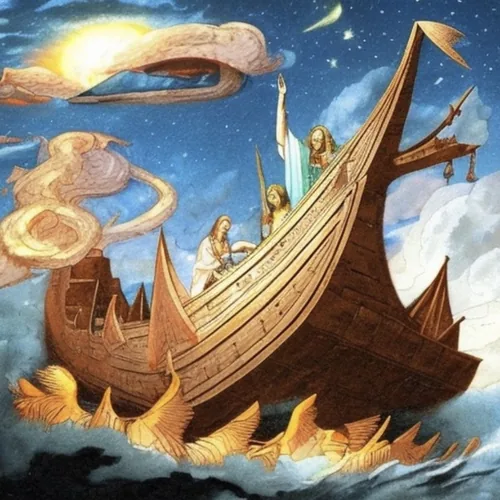
Dylan calls the Javanese sailors and bridge builders, since a brig is a bridge, and follows the word to the pontifex, with the pope as the greatest bridge builder. A bridge sits between two things, and he argues the middleman turns parasitic once it stops being a bridge and becomes a gatekeeper, from the church to merchants skimming profits, the mob, the unions and Hollywood. To leave the system, he says, you must look at the priest system it comes from. Chance's closing takes the same line: the aim is not to crush anyone's spirituality but to strip out the dogma that makes people subservient to middlemen.
Quotes
“All language is the same. It's just different people trying to convey their ideas of what they need.”
“I find that when I spend the time doing what's best for my health and taking the time to do that, I feel like I have more time throughout the rest of the day.”
“It gets to a point where history is so defiled by mythology that you can't separate the two.”
“There's not one hieroglyphic on the three Great Pyramids. So what you're seeing is an older civilization.”
“Every Mason was a priest but not every priest was a mason.”
“We're not really here to crush people's spirituality or the value in some of these ancient mystery school traditions that have passed forward into today in the form of Christianity.”
“It's really interesting how cultures who have no connection to each other could share the exact same astronomical mistakes.”
“If we want to get out of the system and remove its authority, we have to be willing to look at the priest system that it comes from.”
Dylan Saccoccio is the author of the Spirit Whirled series, The Real Universal Empire, and the Tale of Onora. After chasing language back as far as possible, he now explores other avenues to prove cultural diffusion of the ancient universal empire of priests, navigators, masons, and merchants. Find his latest of many hundreds of articles on Substack.
See all Dylan episodes→Kyle and Serena Denton are community herbalists creating wild-crafted and organic plant medicines out of Milwaukee since 2015. I have used their teas and tinctures on an almost daily basis for years now. Kyle is a great friend of InnerVerse and has appeared on the channel more times than I can count. These products work, not in the allopathic "pharma-medicine" way, but in a terrain-support, consciousness bolstering plant-teacher sort of way.