Dylan Saccoccio & Mario Garza | Stellar Arks, Sons of the Sea, Eros & the Godsacre of Eras









Dylan Saccoccio returns to InnerVerse to share the sacred symbolism of the supreme generative power laid up in the mythos of the Ark and the flood hero it bears. Joining us is Mario Garza, to add further observations as we explore the numerous accounts of savior-ships found across countless cultures of all ages, and what hints they may provide to our understanding of an ancient and forgotten universal empire.
 Plus+InnerVerse Plus+
 InnerVerse Plus+
Hear every full episode
Every extended episode, the complete Plus+ archive, premium video and a private podcast feed for your app.
Cancel any time.

Get tuned with Chance
Tuning forks find where energy is stuck in the field around your body and bring it back into flow. Sessions over Zoom, recorded for you to keep.
30 Minute Consultations
Have something to look at, or looking for guidance? We can consult oracular tools, read your chart, or just talk through whatever you choose.
In this episode
Core themes
The Ark as the Master Allegory
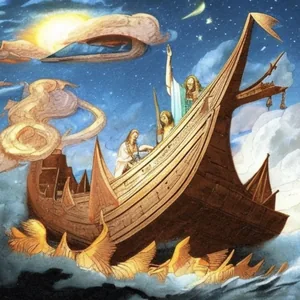
Chance Garton frames the night around one image, the Ark, the Argo Navis, the Arga, the sacred ship that carries the doctrine of world ages. He argues it is the core allegory every other story can be laid over, from Adam buried in the ground to Noah floating above the flood. Dylan Saccoccio and Mario Garza agree the vessel is the microcosm and the earth itself the macrocosm, so a hero entering the cave, the grave or the boat is always the same event, the destruction and regeneration of a world, and the birth of a new era.
Why Dylan Says the Greek Myths Are Not Greek
Saccoccio comes at mythology through language and historicity rather than interpretation. Reading Bishop Thirlwall's history of Greece, he argues the Phoenicians reached the Aegean centuries before Homer and that the Telchines are those same navigators disguised by poetical fiction. He points to the Etruscans, whose ancestors colonized Italy, and says the artifacts that back supposedly Greek stories sit there rather than in Greece. Fallmerayer and Betham supply the harder claim, that modern Greeks are not descended from the ancients and that the Hellenes were barbarous until Phoenician mariners brought them writing, astronomy and the arts of the smithy.
Priestcraft as the Tool of Empire
The practical question Saccoccio keeps returning to is how religions actually spread. Not by preaching, he says, but by building a new god onto the one already worshipped, so Mercury as logos slides easily into Jesus as logos. Behind that sits an order of priests, masons, mariners and merchants moving together, because temples need astronomy and astronomy needs navigators. Garton closes the hour by reading George Faber's 1816 account of priests who personated their deities, wore the dress of women and imitated a hermaphroditic god, which he offers as evidence that church and state were never separate.
Eros, Eras and the Crescent Boat
Looking at an Etruscan vase showing a winged child in a ship, Garton unfolds the pun the episode is named for. Eros is fired from a bow, the bow is the prow of the ship, and the ship is the ark. Quoting Godfrey Higgins in Anacalypsis, he says the cycles of time were like men and died of old age, so every closing era demands a new Eros. The spark leaping between separated poles, Nut and Geb pushed apart by Shu, is the erotic force that regenerates the world and fathers the sacred child.
Where the Three of Them Disagree
Garza reads the material through the pole star, citing The Celestial Ship of the North and linking the great goddess, the arctic and the celestial mill. Saccoccio does not dismiss it, but insists that Marian pole symbolism, including the title star of the sea, is a medieval transcription rather than antiquity, and he refuses to take a position without an inscription. He is equally suspicious of cuneiform evidence surfacing only after the 1700s, alongside the Behistun inscription. Garton brokers the two, proposing that solar imagery tracks the year while polar imagery tracks the precessional cycles.
Quotes
“We are going to be covering some leftovers, if you will, of the God's Acre for Winds of the Soul, fourth book in the Spirit World series by my boy Dylan Saccoccio.”
“What's important about the Argo, the Ark mythos, is how it's one of the core allegories that basically all the stories can symbolically overlay to, even if they don't seem related.”
“The priestcraft is going to be the tool of empire, right? So it's, you're going to either get stuff at the tip of the sword or you're going to convert anyways because you don't know any better, and as a common person you are not privy to any of this.”
“He named me Dylan after the son of the sea in Celtic and Welsh mythology, and so Jesus is also the son of the sea, Mare, right? That's Latin, that's where Mary comes from.”
“Whether it is Adam being buried in the ground when he dies or the flood hero going into the boat, the earth is the ark. So they're looking at this like, basically the way it would be said was, the ark or the Arga is the microcosm, the earth is the megacosm.”
“Boat symbolism, basically there's like a direct correlation with the crescent moon, you know. So I kind of just see almost like a symbolic crescent moon with the boat, and then in between the claws I'm just seeing a lot of Cancerian stuff, because Cancer is ruled by the moon.”
“There's also an allegorical aspect that has to do with the journey of the soul and also has to do with the afterlife, and so psychopomp symbolism, going to the other side, etc. So when I think of ark symbolism, I think of literal arks, I also think of the journey, you know, to the great beyond.”
“The older you get, you start realizing tomorrow's not promised, and what I learned is go till you burn out, because when you burn out, that godly, that creative force, whatever it is you want to call it, it takes over. And so you're never going to know what you're made of until you burn out.”
Dylan Saccoccio is the author of the Spirit Whirled series, The Real Universal Empire, and the Tale of Onora. After chasing language back as far as possible, he now explores other avenues to prove cultural diffusion of the ancient universal empire of priests, navigators, masons, and merchants. Find his latest of many hundreds of articles on Substack.
See all Dylan episodes→Kyle and Serena Denton are community herbalists creating wild-crafted and organic plant medicines out of Milwaukee since 2015. I have used their teas and tinctures on an almost daily basis for years now. Kyle is a great friend of InnerVerse and has appeared on the channel more times than I can count. These products work, not in the allopathic "pharma-medicine" way, but in a terrain-support, consciousness bolstering plant-teacher sort of way.