Plato's Republic Was Atlantis's Enemy: Jack Kelley on The Atlantis Puzzle Book









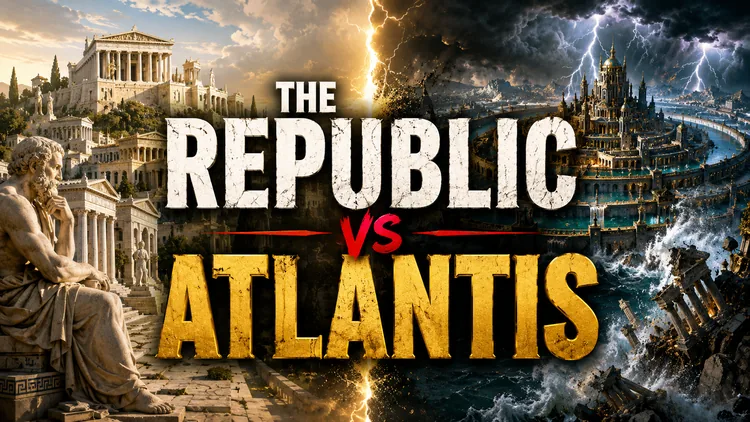
Jack Kelley returns to InnerVerse to discuss his new book, the Atlantis Puzzle. Going beyond the search for a geographical location, Jack's new book uncovers powerful esoteric themes in Plato's writings. This conversation explores the absence of esotericism from academic discourse, the eternal schism between philosophical theory and rational praxis, the ways in which the Atlantis allegory provides important insights into the degradation of modern society, and why mythic literacy may be essential for civilization's psychological stability.
 Plus+Full episode · 2h 25m
 InnerVerse Plus+
Hear the full 2h 25m episode
54 more minutes of this conversation, plus the complete Plus+ archive, premium video and a private podcast feed for your app.
Cancel any time.

Get tuned with Chance
Tuning forks find where energy is stuck in the field around your body and bring it back into flow. Sessions over Zoom, recorded for you to keep.
30 Minute Consultations
Have something to look at, or looking for guidance? We can consult oracular tools, read your chart, or just talk through whatever you choose.
In this episode
Core themes
Esotericism Was the Rule
Kelley traces the book back to George Sarantitus, whose own volume runs roughly 500 pages, far more than the documentary could carry, and to Arthur Melzer's Philosophy Between the Lines, which gathers thousands of quotations from antiquity through the modern age to argue that writing on multiple levels was the rule rather than the exception. Kelley says the idea had vanished from discourse for a couple of hundred years until Leo Strauss revived it at the University of Chicago, and he cites Francis Bacon on the two manners of writing, the enigmatical and the disclosed, the first meant to remove the vulgar from the secrets of knowledge.
Three Reasons to Conceal
Socrates, the philosopher of the Athenian streets, wrote nothing and was tried and put to death around 399 BC on three charges, corrupting the youth, impiety, and introducing new gods to the city state. Kelley argues that Plato answered his teacher's objections to writing by working on layered levels of meaning, and he separates three motives: defensive esotericism, shielding a writer from persecution, whether in Athens, Nazi Germany, or the Stalinist Soviet Union; pedagogical esotericism, which he likens to a calculus teacher assigning problems whose answers he already knows; and protective esotericism, guarding a traditional society from truths thought to be dangerous.
Tradition Against the Blank Page
Every ancient culture, Kelley notes, from Sparta to Persia to an Egypt whose Old Kingdom artwork looks nearly unchanged a thousand years later, held an entrenched identity because survival demanded solidarity. He quotes a line from Rome's Last Citizen that the myth of cultural decline sat as firmly in the ancient mind as the myth of progress sits in ours, then sets against it the purely rational alternative built on a blank sheet of paper: the caste divisions and removal of children in the Republic, the Chinese Cultural Revolution later begging Taiwan for the traditions it destroyed, and Napoleon's attempt at a ten day week.
Two Perfect Societies Annihilate
The Atlantis story survives in two dialogues, Timaeus, which is long and complete, and Critias, which breaks off at roughly a quarter of that length. Critias credits it to Solon's visit to Egypt around 593 BC, where priests described a war 9,000 years earlier, dated in the book near 9,600 BC, between an aggressive Atlantis and a protothenian Athens whose rational city state Plato explicitly equates with the society Socrates had just outlined. Kelley emphasizes that both armies are swallowed by earthquake and flood, that Socrates asks to see his city put into motion, and that the promised third dialogue by Hermocrates was never written.
Vinegar Iron and the Republic
Kelley and Garton read the mutual destruction as the eternal quarrel between theory and practice, the contemplative life against the life of action, with Aristotle's poiesis offered as a possible mercurial bridge and eudaimonia as thriving inside a functioning city state. Philosophy and the traditional polis, Kelley maintains, corrode each other the way vinegar and iron do. He points to the mixed constitution discussed in Plato's Statesman, taken up by Polybius and named at least twice in the Federalist Papers, and warns that the Roman version of that experiment ended when Julius Caesar crossed the Rubicon.
Quotes
“Verily I say unto you listeners, if Plato were alive today, he would want to be on this podcast you're about to hear.”
“I just have to tell you something. The rumors are true. Proceed with caution.”
“That reminds me of something horrifying that my sister likes to say that half of everybody is dumber than the average person.”
“And this sounds nuts because it is the idea that you are protecting society from so-called dangerous truths.”
“The myth of decline or cultural decline was as firmly entrenched in the ancient mind as the myth of progress is in ours.”
“And that means that some of your ancestors were inferior to you and some of them were superior to you.”
“No matter whether you choose to go in the sort of progressive rational way or you stick to the traditional society eventually they're both going to fall apart.”
“The message that's come to me is that what's going on in modern society is we've forgotten how to read the symbolic layer that protects society from its own extremes.”
Jack Kelley is the author of "The Atlantis Puzzle," exploring the ancient Greek Atlantis narrative and its ties to Africa and climate history.
See all Jack episodes→Kyle and Serena Denton are community herbalists creating wild-crafted and organic plant medicines out of Milwaukee since 2015. I have used their teas and tinctures on an almost daily basis for years now. Kyle is a great friend of InnerVerse and has appeared on the channel more times than I can count. These products work, not in the allopathic "pharma-medicine" way, but in a terrain-support, consciousness bolstering plant-teacher sort of way.