The Brazen Serpent, Ophiuchus, and the Solar Code Worldwide | Jason Quitt, Astral Genesis









Is a solar-astrological cipher hidden inside ancient art spanning 12,000 years and every continent on Earth, with your own body as the key that unlocks it? Jason Quitt returns to InnerVerse with the discovery behind his new book Astral Genesis.
Jason Quitt, archaeosymbologist, esoteric researcher, and author of Astral Genesis and Egyptian Postures of Power, returns to InnerVerse to share the solar cipher he believes is encoded in ancient art across 12,000 years and every continent. The conversation covers the brazen serpent of Moses as a solar and Kundalini motif rather than a literal snake, Horus the Savior standing in the tetramorph of the fixed zodiac signs, the Hebrew nachash gematria linking serpent, bronze, and Messiah, the bronze age as the age of the serpent under the pole star Thuban, the human body as the cosmic measuring stick through the cubit and the hand as fifteen and twenty-three-and-a-half degrees of sky, Thoth depicted as a living protractor of the Earth's axial tilt, the precession of the zodiac and the solar sine wave winding through the Milky Way, the Egyptian Book of the Dead read as astrotheology, the unified Set-Horus body at the equinox, the first step of the solar code at the Giza plateau where the sun appears to stand on the back of the Sphinx, the Trinity as the three solstice and equinox suns encoded in the three pyramids, and the per-pharaoh cubit as a tonal-center reset that may link ancient Egypt to ancient China.
 Plus+Full episode · 2h 5m
 InnerVerse Plus+
Hear the full 2h 5m episode
63 more minutes of this conversation, plus the complete Plus+ archive, premium video and a private podcast feed for your app.
Cancel any time.
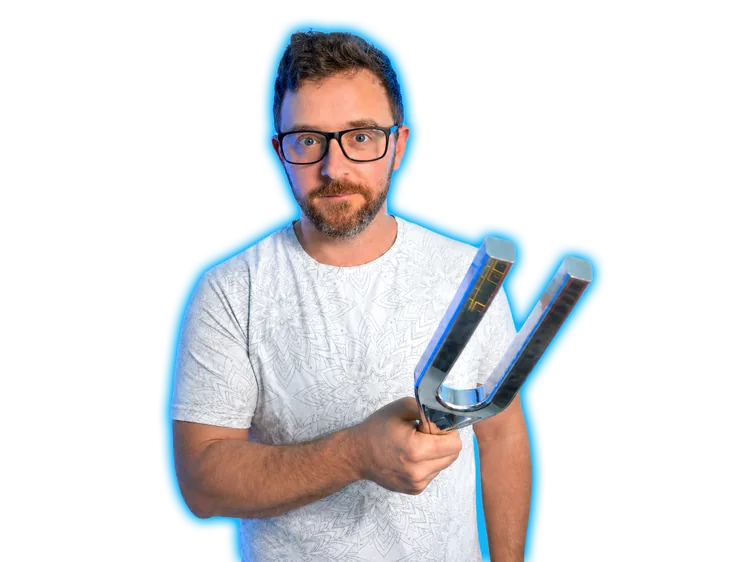
Get tuned with Chance
Tuning forks find where energy is stuck in the field around your body and bring it back into flow. Sessions over Zoom, recorded for you to keep.
30 Minute Consultations
Have something to look at, or looking for guidance? We can consult oracular tools, read your chart, or just talk through whatever you choose.
In this episode
Core themes
A Chapter That Outgrew Its Book
Jason explains that Astral Genesis began as a chapter called The Brazen Serpent, written for his Egyptian Postures of Power work and built on the Pyramid Texts, the Coffin Texts and the Book of the Dead, to show that the soul's journey through the afterlife matches the sun's yearly journey through the constellations. Because he could not reuse other people's pictures, he traced images from tombs in the Valley of the Kings and the Valley of the Queens, and while drawing them he began seeing what he calls a solar code. He pulled the chapter into its own book, which he says holds 50-plus examples spanning about 12,000 years.
Moses' Bronze Serpent and Horus the Savior
In the Old Testament story, Israelites bitten by fiery serpents in the desert are told to look up at a bronze serpent set on a pole, and Jason reads it as the sun's rays climbing to noon or as the kundalini rising toward the north. He traces the motif back to Egyptian Horus the Savior amulets hung above doorways, where the child Horus stands on two crocodiles holding serpents. Jason sees the lion, scorpion, oryx and naked child as the four cardinal points of the zodiac, with Horus as Ophiuchus, the serpent bearer, standing over Scorpius at the galactic center, where he says Serpens is the serpent that heals.
Serpent Words and the Bronze Age Question
Chance says the Hebrew word for serpent, nachash, carries the gematria value 358, the same as the word for messiah, and argues that serpent and salve are linked, which is why fake healers are said to sell snake oil. Jason adds that in ancient Hebrew and Arabic, bronze and serpent were the same word, which leads Chance to wonder whether the Bronze Age is code for a serpent age. Chance argues some seafaring trade had to span the ancient world, pointing to the Phoenicians, said to have sailed around Africa, and to Britain's tin, needed for bronze.
Your Hand as a Solar Clock
Jason describes a very ancient way to measure time: stretch out your arm, hold four fingers against the horizon, and the span equals 15 degrees of sky or one hour of the sun's travel, and two hands span one zodiac house. Because it is a ratio, he says, two people with different cubits get the same measure, and he ties this to the idea of being made in the image of God. He reads a Thoth clapper in the Louvre as a cubit divided into ten and a Thoth figure from Abydos as marking the Earth's 23.5 degree tilt, arguing priests drew such images to encode secret knowledge.
Jason Reads Three Suns at Giza
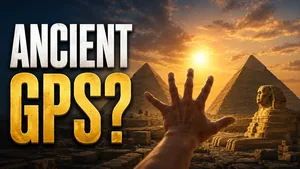
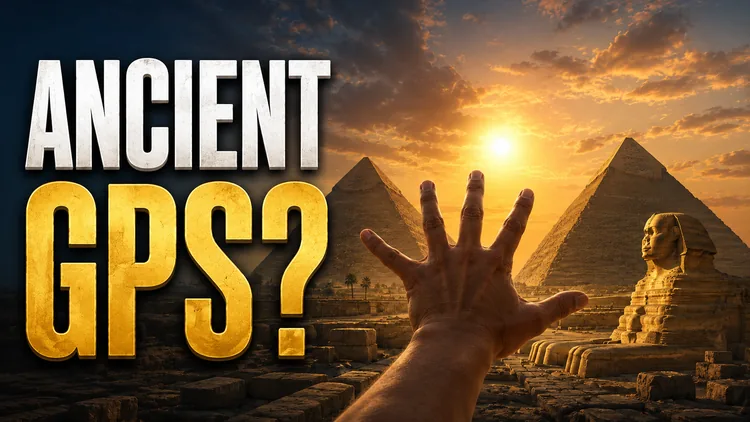
At the equinoxes, Jason says, the setting sun seen from in front of the Sphinx appears to stand on its back, and he reads Khufu, Khafre and Menkaure as the proportions of the summer solstice, equinox and winter solstice suns. Chance ties this to the trinity and says what clicked for him is that the destroyer and the regenerator are one figure, the equinox sun leading toward destruction or regeneration depending on the season, a role he says later theologians misread as a devil. The first hour closes on Akhenaten, with Jason arguing the pharaoh encoded solar measurements into his own depictions to become an Aten god.
Quotes
“If you go look at the myth of Osiris and Horus, it's the same myth that goes on with Orion and Ophiuchus later in the Greek mysteries.”
“The salvation and the serpent have been hand-in-hand for a long time, probably going back to the ancient ophiolatry cults that looked at the sun itself as a serpent.”
“We're getting to the real roots of mysticism, the real genesis of mysticism, which is just learning about the natural cycles, learning about the rhythms, learning about the universe around you.”
“There's so many similarities between ancient Britain and ancient Egypt that seem to link the two in that time period that we call the Bronze Age.”
“If you're standing in front of the Sphinx and you're watching the sunset on the equinoxes, it looks like the sun stands on the back of the Sphinx.”
“What clicked for me was to realize, oh, the destroyer and the regenerator are the same, quote-unquote, person.”
“If you created an instrument or a stringed instrument, wind instrument based on your geometry, then those notes, those frequencies would resonate with you.”
“I think that these depictions of Akhenaten, he was trying to encode the solar measurements into his physical appearance and the physical appearance of his children.”
Jason Quitt is a Canadian author and researcher of ancient mysticism, sacred geometry and archaeo-astronomy, and the founder of The Crystal Sun. A graduate of the Institute of Energy Wellness who has studied energy modalities, shamanism and Qi Gong since 2002, he has taught and lectured on mysticism, meditation and out of body experience since 2010. His books include Egyptian Postures of Power, The Yosef Codes, Astral Genesis, Gates of the Anunnaki and Astral Experiences. His latest, The Shining Island: Precession, Axis Mundi, & Plato's Celestial Allegory, reads Plato's Atlantis not as a sunken empire but as a celestial allegory encoding the fall of the pole star and the precession of the Great Year.
See all Jason episodes→Kyle and Serena Denton are community herbalists creating wild-crafted and organic plant medicines out of Milwaukee since 2015. I have used their teas and tinctures on an almost daily basis for years now. Kyle is a great friend of InnerVerse and has appeared on the channel more times than I can count. These products work, not in the allopathic "pharma-medicine" way, but in a terrain-support, consciousness bolstering plant-teacher sort of way.