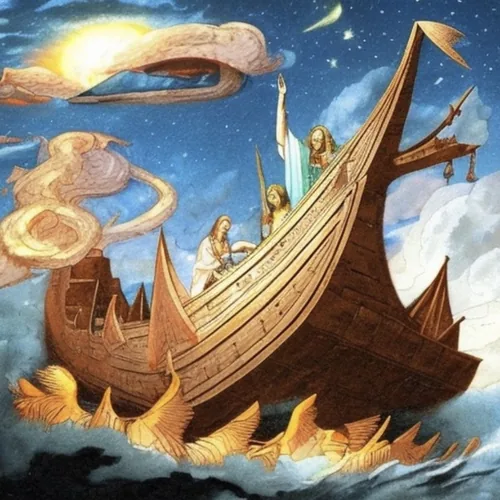
John McHugh | The Celestial Square IKU: Identifying Pegasus as Eden, the Ark, & Al-Qu'ran









The author and Adept archaeo-astronomer John McHugh returns to InnerVerse to reveal more of the Celestial Code of scriptural miracle stories. In this episode John will take us through the innumerable iterations of a sacred square in the heavens, as it morphs through mythologies and becomes the Garden of Eden, the River Oceanus, the Ark (boat and box), and the sacred tablet of Al Qu'ran. All that and some Easter insights too!
The Plus+ Extension is exclusive to Rokfin and Patreon supporters. Subscribe and get access to the entire archive of extended episodes for only $5 (Patreon) or join Rokfin and get all content across the network for $15.
 Plus+InnerVerse Plus+
 InnerVerse Plus+
Hear every full episode
Every extended episode, the complete Plus+ archive, premium video and a private podcast feed for your app.
Cancel any time.

Get tuned with Chance
Tuning forks find where energy is stuck in the field around your body and bring it back into flow. Sessions over Zoom, recorded for you to keep.
30 Minute Consultations
Have something to look at, or looking for guidance? We can consult oracular tools, read your chart, or just talk through whatever you choose.
In this episode
Core themes
The square in the sky that holds a dozen stories
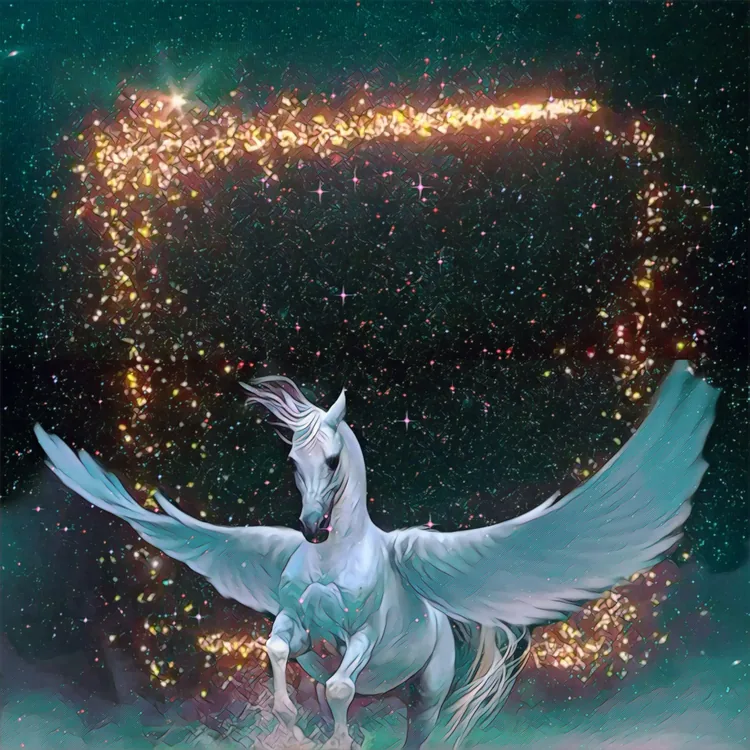
John McHugh's whole case rests on four stars the Babylonians called the IKU, a sacred irrigated field that later became the Pegasus Square. He lays out how that one celestial box morphs into a flying horse, into the river god Ocean who encircles the earth, into the Garden of Eden, into Noah's ark as both boat and box, and into the heavenly tablet on which Islam says the Quran is kept. Chance Garton calls it possibly the most fascinating piece of astro theology, and John admits the title of his own slide could barely hold the greatest hits.
Why cuneiform signs carry a hundred meanings
The engine of the argument is polysemy. John explains that cuneiform has roughly six hundred signs, and each one carries many readings, so the single sign AN can mean sky, deity, star, barley, mine, and even to impale on a stake. The Sumerians invented the script around 3000 BC, Sumerian died as a spoken tongue near 1800 BC, and the Akkadian speakers kept it alive through logograms and Sumerian Akkadian dictionaries. Chance suggests the tangle grew because scribes in different temples abbreviated the same signs differently and later generations inherited every meaning as true.
Wordplay treated as divine revelation
For Mesopotamian scholars, finding a pun was finding a secret. John points to the phrases amat natsirti, hidden words, and pirishtu shai ili, secrets of the gods, and to Scott Noegel's work on punning, where a name embodies the essence of its bearer. His clearest proof is Enuma Elish tablet seven, where the fifty Sumerian titles of Marduk generate all one hundred sixty three lines through wordplay, including the line about the god Nibiru crossing. He also notes that the papal office rests on a pun, since Jesus calls Peter rock and builds a church on it.
Homer as a Babylonian hostage
How did more than half the Mesopotamian constellations reach Greece? John rejects the polite story about traders swapping techniques in Phoenicia. John argues that Hesiod, the first Greek to mention Pegasus around 700 BC, draws his themes straight from Enuma Elish. Daniel is a hostage astrologer under Nebuchadnezzar, Zenodotus of Mallus claimed Homer was a Babylonian, and Lucian's mock interview has Homer say his name was Tigranes before captivity. Homer literally means hostage. John's theory is that a Babylonian tupsharru, taken as booty in an eighth century raid, taught the constellation writing directly to the Greeks.
Rock art, hierophanies and when to pray
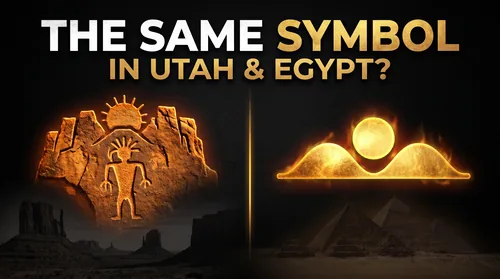
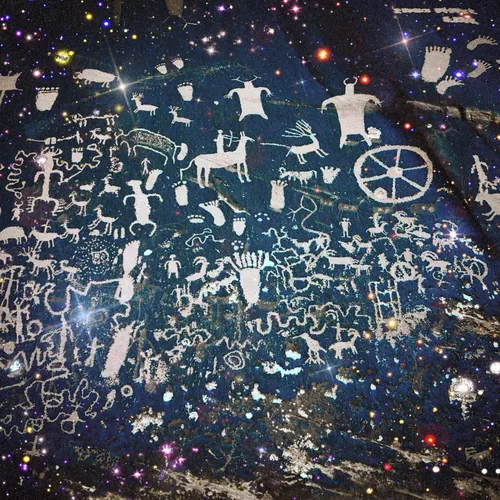
Before the decode, John shares his other life as lead archaeologist for the Utah Cultural Astronomy Project, studying Fremont and ancestral Pueblo petroglyphs. He shows a thousand year old pictograph whose headdress lights at summer solstice, a pendant marking thirteen moons and the eighteen point six one year lunar standstill, and kivas aligned to solstice sunrises. His practical advice is to pray at sunrise, sunset and solar noon, build during a waxing moon, release during a waning one. Chance adds that Easter itself is pagan, linking the word to Ishtar, the Norse Aesir and the Etruscan Iser.
Quotes
“Everybody once even the youngest child, once they find out about a flying horse named Pegasus, they they fall in love with it. But the history of Pegasus might be more intriguing and far more serious than a child's toy.”
“Well, the secret intelligence agency program where they're working on this tesseract cube square is called the Pegasus Project.”
“It just basically shows that the the stories that we call we recorded as miracles in Judaism, Christianity, Islam and pagan religious mythology actually have templates as pictures in the stars.”
“So, like, you know, after reading your work and and seeing how well it sync syncretizes with other research, the IKU field being the arc actually in a lot of ways is more fitting than the constellation that is currently called Argo, you know?”
“We'll talk about the ark being the IKU, being the the Gilgamesh epic, in Tablet 11, the flood story of the Gilgamesh epic. The ark is literally the IKU constellation. It says, build yourself an IKU constellation. So I'm like, OK, I think this might be a celestial myth.”
“It's fascinating to consider that this was bi-directional. The future, yes, but also this is how you create the supporting foundational narrative of your, quote, ancient history, unquote, to justify the existence of your empire or your dynasty.”
“I think it simplifies the whole equation to just say they're using the same type of methodology and they're using the same text that they're translating from, the text being the sky, the methodology being puns and polysemy of their own languages.”
“I'm saying that Homer is actually probably a Babylonian or an Assyrian, that he was maybe a Babylonian astrologer, knew lumashi writing, was taken captive, brought to the Greeks, learned Greek, and then taught this system directly to the Greeks.”
John McHugh is a scholar of Middle Eastern and Native American archaeoastronomy and author of The Celestial Code of Scripture, which traces celestial and linguistic origins of biblical miracle stories; he has appeared on InnerVerse multiple times (Star of Bethlehem, Rock Art, Pegasus/Ark, Celestial Code).
See all John episodes→Kyle and Serena Denton are community herbalists creating wild-crafted and organic plant medicines out of Milwaukee since 2015. I have used their teas and tinctures on an almost daily basis for years now. Kyle is a great friend of InnerVerse and has appeared on the channel more times than I can count. These products work, not in the allopathic "pharma-medicine" way, but in a terrain-support, consciousness bolstering plant-teacher sort of way.