Polar Cosmology, Simulacra, and Mercury as the Axis Mundi | Mario Garza, Symbolic Studies









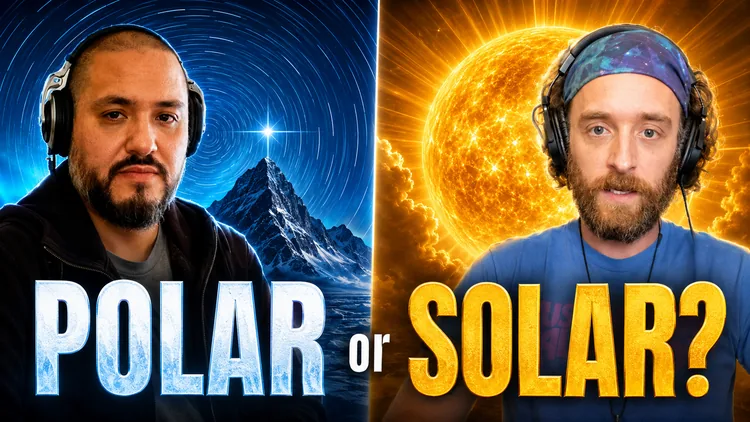
Mario Garza of Symbolic Studies argues that every major deity in antiquity was originally a polar god before the solar model was imposed over them, and Baudrillard's simulacra explains exactly how that inversion was achieved and kept in place.
Covers polar cosmology as the original paradigm buried by the heliocentric model, Mercury and Hermes and Thoth as inherently polar gods with the caduceus as the axis mundi, the spine's 33 vertebrae as the body's polar column, Baudrillard's simulacra and how the solar perspective instills external psychological dependency, the Norse inversion of sun and moon polarity, art as the path of individuation, and the Thoth Tarot Art card as destruction and transformation at the root of creative freedom.
 Plus+Full episode · 2h 33m
 InnerVerse Plus+
Hear the full 2h 33m episode
75 more minutes of this conversation, plus the complete Plus+ archive, premium video and a private podcast feed for your app.
Cancel any time.

Get tuned with Chance
Tuning forks find where energy is stuck in the field around your body and bring it back into flow. Sessions over Zoom, recorded for you to keep.
30 Minute Consultations
Have something to look at, or looking for guidance? We can consult oracular tools, read your chart, or just talk through whatever you choose.
In this episode
Core themes
Art as the Path to Individuation
Mario traces Symbolic Studies back to childhood doodling, a Kubrick obsession that carried him into film school, and a later turn toward tarot, and he argues that art is the key to individuation, that being an artist is doing your shadow work, and that creativity and freedom are inseparable. He cites Crowley's line that destruction is the first act of creation, and says his own finished pieces keep teaching him things he never intended months after he made them. Chance, a former film studies minor, adds that it almost doesn't matter what you create, only that you do.
Simulacra and the Map That Replaced the Land
Mario read Baudrillard's Simulacra and Simulation for a small book club and now uses the word model for it: the models handed to us about how the sky, science and reality work eventually flip into their opposites, so news outlets mislead and schools blunt knowledge. He points to cartography, where copies of copies made the map realer than the land it described, and notes how often modern maps crop the poles away. Chance frames the same idea through screens, saying we accept truth from black mirror scrying devices and let that overlay filter out what our own senses report.
Polar Gods Made Solar
Mario's central claim is that deities we now file as solar were revered as polar first, with Mercury the clearest case: the Magician lifting his wand, the phallus, the caduceus rod with its two snakes, and by extension Hermes and Thoth. He reads the spine and its 33 vertebrae as the same pole expressed in the body, and the toroid's center as the trunk of the world tree and a gateway between realms. Chance layers initiation on top of it, describing a literal story, then a solar one, then a polar one, then the truth that all of it exists within you.
Earth Shape Agnosticism and the Apophatic Method
Mario dates his interest to 2014, reading Eric Dubay on a flight to India, and the story he tells is of a young man in Mumbai who volunteered, unprompted, that his guru teaches a stationary Earth. He calls himself agnostic about the shape and more interested in whether the realm is geocentric. Chance answers with method rather than a model, arguing that truth is approached apophatically by ruling out what it is not, that one inversion at the base of a worldview leaves everything above it unstable, and that a source caught lying a dozen times has earned no further trust.
The External Savior and Taking Responsibility
Chance builds the closing argument: if the solar perspective is at root a feminine, goddess oriented one, it explains the sacrificial streak in ancient sun cults and, he suggests, reappears in the external savior at the heart of communism and of the redeemer myth, where a solar deity dies for everyone and sets the example. His counter is that if everyone sacrifices themselves nobody is left, so the heroic move is to take responsibility for your own freedom. Mario had already supplied the psychology, noting that when everything is external you stop trusting your own senses.
Quotes
“I think that in order to be a free person, you have to be creative, and I think that there's this inherent link with creativity and freedom that's inseparable.”
“It almost doesn't matter what you create, just that you do.”
“At a certain point, the map became more real than the actual land mass, right? So what happens when the cartographers haven't even seen the land themselves and they're just copying other maps?”
“There's the literal story, then there's the sun god solar story, then there's the polar story, and then there's the all of this exists within you truth.”
“Everything seems to be a symbol of the pole of some kind.”
“All it would take is one inversion in the foundation of a belief system or a worldview, and everything that's built upon that would have an unstable ground.”
“With solar psychology, because everything is external, you don't even trust your own senses anymore, which is the wildest thing.”
“If we all take responsibility for our own freedom and for our own self in a heroically masculine way, male or female, then we're all good.”
Mario Garza is the artist and researcher behind Symbolic Studies, a project sharing symbolic insights on the zodiac, mythology, folklore and world religions, with astrology as its foundation. A lifelong artist who has worked as an art director and graphic designer for nearly 25 years, he runs Symbolic Studies from the Pacific Northwest alongside his wife Michelle, who co-hosts the podcast with him. His work traces syncretic threads across tarot, occultism and comparative religion, including the argument that the major deities of antiquity were originally polar gods before a solar model was laid over them. He also offers symbolic birth chart and tarot readings, private lessons and freelance design.
See all Mario episodes→Kyle and Serena Denton are community herbalists creating wild-crafted and organic plant medicines out of Milwaukee since 2015. I have used their teas and tinctures on an almost daily basis for years now. Kyle is a great friend of InnerVerse and has appeared on the channel more times than I can count. These products work, not in the allopathic "pharma-medicine" way, but in a terrain-support, consciousness bolstering plant-teacher sort of way.