Marty Leeds | The Definite Super Knowledge: Gnosticism Defined and the Tenets of the Order









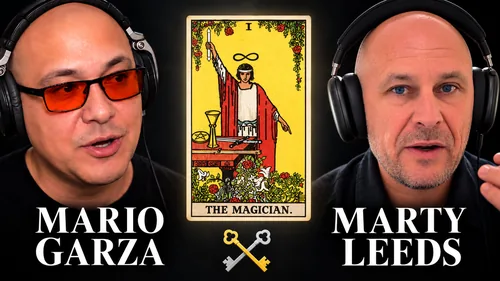
Marty Leeds returns to InnerVerse! As the Gnostic Academy's Preacher-Teacher, Marty has been delivering transcendent truths and mathematical mysticism for years, with Biblical analysis that you're not going to find at the average Sunday School. We discuss his new book, Gnosticism Defined: The Tenets of the Order, the Prisca Theologia, and his stance on sin & salvation, misconceptions on the demiurge, symbolism of the serpent, and the origin of evil.
In the Plus+ Extension we explore the essential beneficence of the world, the sacrificed savior, a theory on where Judaism began, problems with scapegoating, the world age doctrine, cyclical time, reincarnating world teachers, stellar origins of Islam, the "contact experience," the spiritual place for psychedelics, and much more!
 Plus+Full episode · 2h 21m
 InnerVerse Plus+
Hear the full 2h 21m episode
65 more minutes of this conversation, plus the complete Plus+ archive, premium video and a private podcast feed for your app.
Cancel any time.

Get tuned with Chance
Tuning forks find where energy is stuck in the field around your body and bring it back into flow. Sessions over Zoom, recorded for you to keep.
30 Minute Consultations
Have something to look at, or looking for guidance? We can consult oracular tools, read your chart, or just talk through whatever you choose.
In this episode
Core themes
Gnosis Is Experience, Not a Belief System
Marty Leeds opens by separating historical Gnosticism from gnosis itself, which he defines simply as knowledge of spiritual mysteries received experientially rather than handed down as dogma. He tells Chance Garton that gnosis carries no stipulations and no list of required beliefs, and that it belongs to what he calls the mystery school tradition, the umbrella covering Rosicrucianism, the Knights Templar, Freemasonry and alchemy. Every one of those paths, pursued honestly, leads back to Christ in his view, which is why he named his congregation the Gnostic Church and Academy of Lord Jesus Christ.
Salvation You Cannot Outsource
Chance Garton presses on the Baptist model he grew up with, where saying the right words in front of a preacher settles your eternity regardless of how you live afterward. Marty Leeds answers that no pastor, priest or preacher makes that determination, that salvation is between you and God, and that it is the same idea other cultures call apotheosis, deification or enlightenment. He frames it as an autodidact hero's journey demanding all of your strength, knowledge and heart. Chance compares outsourced faith to allopathic medicine, an externalized authority people learned over generations to let fix things for them.
Marty Reads Demiurge as Demonic of the People
The pop culture demiurge, the prison planet and the simulation get dismantled here. Marty Leeds argues the position collapses philosophically, since a malevolent creator made by God pushes the evil back onto God, and since anyone who truly believed the world was a prison would never start a family. Going to the word itself, he reads demiurge as demonic of the people, meaning the world age is built by the evil accepted in the hearts and minds of humans. Chance Garton adds his own objections, including that the doctrine exalts evil far past anything reasonable.
The Devil, Winter and the Natural Order
Chance Garton traces the consonants of devil to the Hebrew word for world, tuval, and to Tubal Cain the craftsman, arguing the devil figure allegorizes nature's destroying aspect, the winter that makes spring possible. Marty Leeds agrees that world archaically meant the age of man, so the devil ruling this world simply describes what people accept in a given era, from routine circumcision to rampant porn. Neither man accepts that matter is evil. Genesis calls creation good, they note, and sin becomes anything done against the natural order God laid out, which visibly rots and sterilizes.
Nag Hammadi, Eusebius and Suspicious Provenance
In his closing solo commentary Chance Garton turns to the Nag Hammadi library, thirteen codices supposedly found by a teenage farmer near Nag Hammadi in 1945, and questions the antiquity and the conflicting discovery accounts rather than calling it fake outright. He notes the Codex Alexandrinus enters the record only in the seventeenth century and the Codex Sinaiticus only in 1844. Citing Eusebius on the Egyptian Therapeutae and the Reverend Robert Taylor's commentary, he argues Christianity descends from a much older Alexandrian mystery tradition, and reads the treatise of the great Seth and the teachings of Silvanus as recycled deities.
Quotes
“It doesn't have a bunch of dogma or a bunch of stipulations like, Oh, you have to believe in this and this and this and this. That's just not what it is about.”
“say like the Baptist Church I grew up in where it was, if you just believe this and say the right words in front of the preacher, that you've accepted Jesus into your heart as your savior, then no matter what you do for the rest of your life”
“this is an autodidact hero's journey that you're on. And if you do want to reach apotheosis, enlightenment, salvation, whatever it is, that ultimate connection with God, then, you know, it's going to it's going to take everything in you.”
“It cannot be concealed. It's like all you can do is distract from it, distract yourself from it or distract others from it.”
“Then then why in the fuck would you ever want to get a woman pregnant? Why would you ever want to have a family? Because what are you doing? Then you are willfully literally bringing more prisoners into the prison.”
“So there's nothing inherently, quote unquote, evil about earth. That said, matter is the place in which evil is allowed to exist.”
“But the real malice in the world comes from the manufacturing of consent and the trickery of getting someone to do it to themselves.”
“this isn't to say there's no value in the philosophy of these systems. There is, but we gotta get straight like what it actually is telling us and what it's supposed to be rather than trying to think that it's what we're told it is by the mainstream.”
Marty Leeds is a gematria researcher, author and preacher who founded The Gnostic Church and Academy of Lord Jesus Christ in 2022, where he serves as head teacher and spiritual leader. A working minister since 2011, he is the author of more than ten books, among them the Pi & The English Alphabet series, Scripture in the Stars, The Keys to the Tarot and Gnosticism Defined: The Tenets of The Order, built around a mathematical cipher he says is hidden beneath the English alphabet. His teaching centers on Prisca Theologia, the idea of a single wisdom underlying the world's religions, drawing together gematria, Kabbalah, astrology and comparative mythology. He streams weekly sermons free through the Gnostic Academy's YouTube and Rumble channels.
See all Marty episodes→Kyle and Serena Denton are community herbalists creating wild-crafted and organic plant medicines out of Milwaukee since 2015. I have used their teas and tinctures on an almost daily basis for years now. Kyle is a great friend of InnerVerse and has appeared on the channel more times than I can count. These products work, not in the allopathic "pharma-medicine" way, but in a terrain-support, consciousness bolstering plant-teacher sort of way.