Mario Garza (Symbolic Studies) | The Wheel, the Bull, and the Chariot That Doesn’t Move
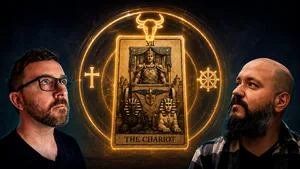









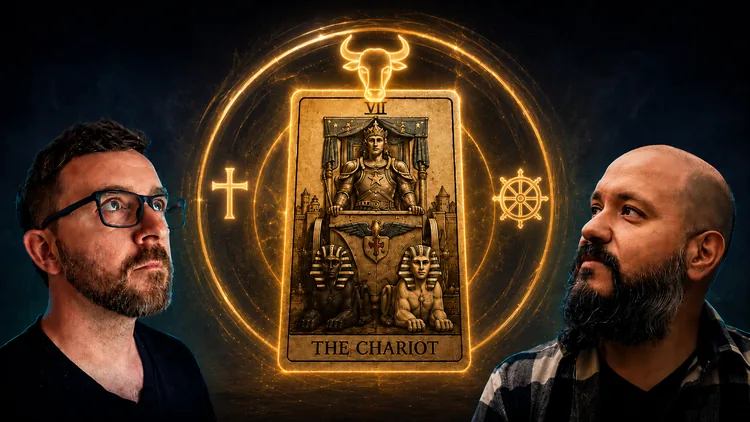
The Dharma wheel. The Christian cross. The Egyptian bull god. Symbolic researcher Mario Garza of Symbolic Studies returns to InnerVerse for a freeform exploration of a central metaphysical pattern, questioning if that pattern may be the architecture of reality itself.
Why does the Rider-Waite Chariot card show wheels pointed sideways and sphinxes that aren't even harnessed? What does the bull have in common with the cross? Why did nearly every ancient culture place a bull, a tree, or a still point at the center of its cosmology? And what does any of this mean for the spiritual journey in an age of accelerating modernity? Topics traced: the unmoved mover, the still center versus the spinning circumference, bull symbolism across Vedic, Buddhist, Egyptian, Greek, and Phoenician traditions, the philological golden thread connecting wheels, bulls, bills, and lords, René Guénon's reign of quantity, and why "going with the flow" is centripetal physics in metaphysical disguise. The extended conversation follows the wheel and bull symbolism thread into the modern world, tracing the reign of quantity, the acceleration of time, and what ancient metaphysics has to say about the age of AI and digital consciousness.
 Plus+Full episode · 2h 4m
 InnerVerse Plus+
Hear the full 2h 4m episode
60 more minutes of this conversation, plus the complete Plus+ archive, premium video and a private podcast feed for your app.
Cancel any time.
Get tuned with Chance
Tuning forks find where energy is stuck in the field around your body and bring it back into flow. Sessions over Zoom, recorded for you to keep.
30 Minute Consultations
Have something to look at, or looking for guidance? We can consult oracular tools, read your chart, or just talk through whatever you choose.
In this episode
Core themes
The Still Center of the Wheel
Mario Garza's central claim is that a wheel teaches metaphysics all by itself. The rim stands for action, dispersion and becoming, while the hub stands for unity, stillness and being, so the spiritual journey becomes a movement inward toward your own still center. He points to the unmoved mover, the pole star turning the sky by staying fixed, Buddha meditating inside the dharma wheel, and Christ nailed to the cross as the axis that makes everything else revolve. Chance Garton adds a physics gloss, calling the centripetal draw toward the center going with the flow, and centrifugal flinging the price of fighting it.
A Chariot Fused in Stone
A long stretch reads the tarot as evidence for that same stillness. Mario notes that the Rider Waite charioteer sits fused in cubic stone, that his sphinxes are seated and not even harnessed to the vehicle, and that older decks draw the wheels crooked and pointed sideways, so the thing cannot roll at all. He reads the Thoth deck's Universe card as hidden ark symbolism, with the fixed creatures spewing flood water under Saturn, and only the bull given swirling eyes. He also traces the major arcana from the Fool as aleph, meaning ox, to the final card as tau.
The Bull at the World Axis
Both speakers place the bull at the center rather than out on the rim. Mario sets Taurus on the world axis, citing a Vedic bull that occupies the central axial position and arguing that a fixed sign suits something rooted like a tree or a mountain. Chance offers the Buddhist myth of dharma as a bull that loses a leg each age until the iron age leaves it standing on one, then swaps T for D to hear tarma inside Taurus. Mario answers with Ursa Major as the thigh of the bull, plus one legged figures like Mercury and a spinning ballerina.
The Golden Thread of Baal
Chance calls his linguistic method the golden thread of the bull, built on letter swaps he treats as valid rather than accidental. B trades with V, P with B, L with R and T with D, so the Hebrew par becomes ball, abir reads as father bull, the storm god El carries bull imagery, and the Greek stauros that Jesus hangs on sounds like Tauros with an S in front. He follows the thread into paying a bill, posting bail, the Greek boule as a secret council, and papal bulls, insisting Baal is a title meaning lord rather than a devil.
Poles, Thrones and a Malleable Sky
The closing turn asks where the center went. Mario says a leader symbolically stands as a pole that gives people orientation, which is why the tarot thrones the High Priestess through the Hierophant before the Lovers breaks the pattern, and why an Egyptian obelisk sits inside a giant keyhole in Vatican Square. Chance argues heliocentric models offer no conceptual center at all, and raises Fomenko's statistical dating of the Almagest to the Renaissance. Mario answers with Christian sky maps and an ancient Chinese zodiac of eight polar constellations later moved onto the ecliptic, suggesting the sky is more malleable than assumed.
Quotes
“A picture is worth a thousand words, but a symbol is worth infinity. Like, there is no bottom to a symbol.”
“The bull itself has a whole history where it literally relates to the central axis, and it is in the center of the wheel itself.”
“The Greek word for cross is stauros. It's Taurus with an S at the beginning.”
“Let's get past this boogeyman gatekeeper, you know, bouncer essentially, and look further into Baal, because it's not even evil. It's just a title that means Lord.”
“The sphinxes, which are supposed to be the draft animals that pull him, they're actually seated, so they're not going anywhere.”
“It's as though the cross is the wheel for the West.”
“The spiritual journey is like the journey towards the center of the wheel, basically. So we're all kind of like our own wheel.”
“You have sin, which is a debt to the gods, something you've transgressed, so you owe. So to pay the bill, you offer a bull.”
Mario Garza is the artist and researcher behind Symbolic Studies, a project sharing symbolic insights on the zodiac, mythology, folklore and world religions, with astrology as its foundation. A lifelong artist who has worked as an art director and graphic designer for nearly 25 years, he runs Symbolic Studies from the Pacific Northwest alongside his wife Michelle, who co-hosts the podcast with him. His work traces syncretic threads across tarot, occultism and comparative religion, including the argument that the major deities of antiquity were originally polar gods before a solar model was laid over them. He also offers symbolic birth chart and tarot readings, private lessons and freelance design.
See all Mario episodes→Kyle and Serena Denton are community herbalists creating wild-crafted and organic plant medicines out of Milwaukee since 2015. I have used their teas and tinctures on an almost daily basis for years now. Kyle is a great friend of InnerVerse and has appeared on the channel more times than I can count. These products work, not in the allopathic "pharma-medicine" way, but in a terrain-support, consciousness bolstering plant-teacher sort of way.