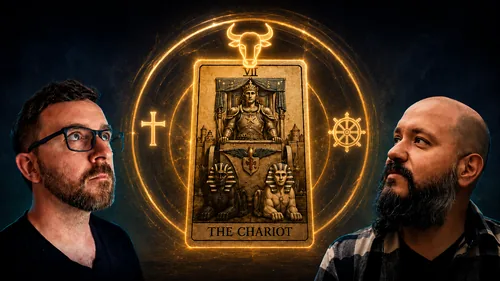
The Reign of Quantity & the Truth About Our Time with Mario Garza of Symbolic Studies | Vibe Rant ep 155









Are we truly in the Kali Yuga, or Iron Age? How does the Reign of Quantity over Quality inform the solidification, rise of materialism, and eventual destruction & regeneration of the world? Mario Garza of Symbolic studies joins me to discuss "The Reign of Quantity and the Signs of the Times" by 20th century mystic René Guénon, and the patterns of the great wheel of time revealed by this esoteric sage.
 Plus+InnerVerse Plus+
 InnerVerse Plus+
Hear every full episode
Every extended episode, the complete Plus+ archive, premium video and a private podcast feed for your app.
Cancel any time.

Get tuned with Chance
Tuning forks find where energy is stuck in the field around your body and bring it back into flow. Sessions over Zoom, recorded for you to keep.
30 Minute Consultations
Have something to look at, or looking for guidance? We can consult oracular tools, read your chart, or just talk through whatever you choose.
In this episode
Core themes
The Wheel and Its Center
Chance Garton and Mario Garza build the episode around Rene Guenon's The Reign of Quantity and the Signs of the Times, a book Garza says many readers consider Guenon's magnum opus and which Garton read in full before the stream. Garza uses a wheel as the master image, with the hub standing for the primordial tradition, principal unity and the sacred center, and the rim standing for multiplicity, earth and materialism. Garza relays Guenon's claim that a cycle quickens toward its end like a wheel rolling downhill, while Garton adds Guenon's stranger figure of the circle bending into a cube until motion halts and the age begins again.
Vocation Against the Machine
Both men linger on Guenon's chapters on the artisan, where each person fulfilled the function implicit in his own nature and, Garza says, every occupation carried a priesthood or guild behind it. Garton reads Guenon's line that the machine is in a sense the opposite of the tool, since the tool prolongs the man while the machine reduces him to its servant, and that if the tool engenders the craft, the machine kills it. Garza contrasts a traditional household, where nothing was anonymously made, with an office full of objects of unknown origin, and Garton frames his own show as vocational expression won by a leap of faith.
When Number Becomes Reality
Garton carries the argument into science, noting that modern chemistry appropriated the word element to mean a census of materials distinguished by counted particles, so hydrogen and helium differ by one proton rather than by essence. He revisits Zeno's paradox of Achilles and the tortoise as an early protest against atomism, points out that quantum is itself just a reference to quantity, and argues that much of astrophysics amounts to numbers fed into computer simulations. He quotes Guenon's formulation that quantity is never that which is measured but that by which things are measured, then ties the same inversion to the hard problem of consciousness.
Coinage Gold and Bitcoin
Garza raises Guenon's chapter on the degeneration of coinage, describing coins as sacred totems whose worth lay in their iconography before value collapsed into purchasing power, and citing an uncollected Guenon article arguing that gold was so sacred that owning it made no sense. Garton adds a philological weave linking coin, cohen, king and Cain, and reads Tubal-cain as Vulcan through the interchange of vav and bet. He recalls that old gold was tested by biting it, sets that against Bitcoin's digital coin logo and talk of universal basic income, and reads Mr. Beast's contestant counts and prize totals as the reign of quantity on screen.
Cain Abel and Subjective Time
Garza summarizes Guenon's Cain and Abel chapter as a contest between sedentary and nomadic peoples, with settled cultures favoring the plastic arts of agriculture, architecture and image while nomads favor music and poetry, arts that unfold over time. He links the pattern to Romulus and Remus and to a documentary about a Mongolian herder blocked by borders and taxes from following the swans. Garton separates the compressive clock time of uniform working weeks from the expansive subjective time of music festivals, and recounts moments when time paused for him entirely. He also reads Guenon's warning that animals counted too often die in greater numbers.
Quotes
“So if mankind has gone through something of a fall or of a descent, we're moving further away from this principal unity. We're moving further away from essence or quality.”
“The quantitative is the illusory. Which is why as it becomes more and more prominent as the lens through which people see reality, people become more and more divorced from the truth.”
“There wasn't anything that you put in your body. There wasn't anything that you wore. There wasn't anything in your immediate vicinity that was basically anonymously created.”
“I thank God for every day that my life gets to be the vocational expression of doing what I feel like I'm here to do.”
“So the person who's only thinking in quantitative purchasing power terms, that's how they walk through life and that's how they see everything.”
“I have had experiences where time not only expanded or contracted, but actually paused. I have exited time before.”
“So to stop a nomadic person from traveling is basically like putting them in prison.”
“Communism had this promise of the workers utopia and that, you know, resources and wealth would be equally distributed and there would be this quantitative uniformity for everyone, and everyone starved.”
Mario Garza is the artist and researcher behind Symbolic Studies, a project sharing symbolic insights on the zodiac, mythology, folklore and world religions, with astrology as its foundation. A lifelong artist who has worked as an art director and graphic designer for nearly 25 years, he runs Symbolic Studies from the Pacific Northwest alongside his wife Michelle, who co-hosts the podcast with him. His work traces syncretic threads across tarot, occultism and comparative religion, including the argument that the major deities of antiquity were originally polar gods before a solar model was laid over them. He also offers symbolic birth chart and tarot readings, private lessons and freelance design.
See all Mario episodes→Kyle and Serena Denton are community herbalists creating wild-crafted and organic plant medicines out of Milwaukee since 2015. I have used their teas and tinctures on an almost daily basis for years now. Kyle is a great friend of InnerVerse and has appeared on the channel more times than I can count. These products work, not in the allopathic "pharma-medicine" way, but in a terrain-support, consciousness bolstering plant-teacher sort of way.