Transform Your Life with Nature | James Frosch on Fungi & Homesteading









James Frosch of Family Fungi joins InnerVerse to explore the healing power of regenerative living, from mushrooms and medicinal herbs to intuitive gardening and the sacred relationship between soil, spirit, and self.
We talk about the real work of sovereignty, the magic of spent mycelium, and how healing doesn't come in a bottle, it grows from the land beneath your feet.
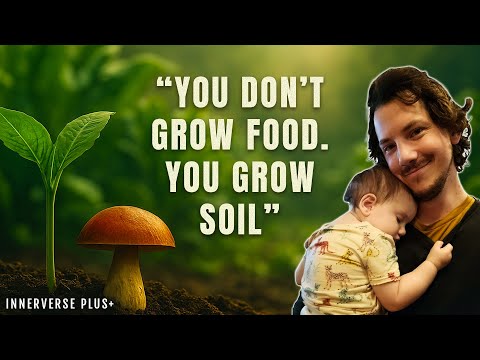 Plus+Full episode · 2h 18m
 InnerVerse Plus+
Hear the full 2h 18m episode
62 more minutes of this conversation, plus the complete Plus+ archive, premium video and a private podcast feed for your app.
Cancel any time.

Get tuned with Chance
Tuning forks find where energy is stuck in the field around your body and bring it back into flow. Sessions over Zoom, recorded for you to keep.
30 Minute Consultations
Have something to look at, or looking for guidance? We can consult oracular tools, read your chart, or just talk through whatever you choose.
In this episode
Core themes
Spent Mushroom Blocks Become Garden Soil
Frosch describes Family Fungi as a mushroom farm whose most valuable output is not the mushrooms but the spent mycelium blocks left after one or two flushes, which stop being commercially viable once they take up shelf space. He drives 25 to 30 minutes to a local sawmill, takes the hardwood waste stream from lumber headed into people's houses, grows it out, then returns it to the ground. In South Louisiana, with its very high water table and heavy clay, he says the blocks need about eight months to break down into something he compares to rich Dutch chocolate cake, and stacked in thirties they keep fruiting in the garden.
Quantity Farming Versus Qualitative Nourishment
Garton argues that people treat food like putting gas in a car, judging only whether the tank is full, while Frosch calls boxed products food stuff: made from food, but no longer food. Frosch says he takes issue with organic labeling loopholes, observes that hurricane shelves empty first of pop tarts and beer, and estimates his family produces roughly 20 percent of its calories from about a quarter acre of intensive perennial and mixed annual planting on their four acres. Garton frames industrialization as a genuine answer to an old problem, feeding everyone, that has now produced a new one worth tackling.
Where A Beginner Should Start With Fungi
Asked what a novice should cultivate, Frosch names oyster mushrooms first: easy at home from a grow kit or from spawn on hardwood sawdust, expandable into fresh wood chips or freshly cut logs, widely available and forgiving of neglect. He puts reishi second, grown on a countertop, harvested fresh and dehydrated for tea, or extracted in neutral spirits such as vodka or brandy, with the 190 proof organic alcohol his farm uses as one option and a charcoal filter recommended for vodka. Third is king stropharia, the wine cap or garden giant, which he says will only fruit with soil organisms and a casing layer.
Soil As A Living Sub Aquatic System
Frosch separates saprotrophic fungi that break down hardwood from mycorrhizal fungi that partner with tree roots, calling the latter the unsung heroes of the food chain for extending root systems enormously and mining minerals with acids like oxalic acid that plants cannot produce. He cites a line he heard from Matt Powers and John Kempf that soil is a sub aquatic system, roughly 20,000 gallons of water per acre in the first foot. He also reports that oyster mushrooms can remediate nematodes, which cause the root knot that once cost him a whole sweet potato harvest.
Weeds, Books And Permission To Start
Frosch's land was a strawberry plantation 60 to 70 years ago and pine forest savanna before that, and he says it was strip mined for minerals, so he now reads weeds like thistle as indicators of deficiency, uses no herbicides, and mulches or does a chop and drop instead. For study he points to the Louisiana Herb Journal, Matt Powers on regenerative soil, John Kempf on bio fertilizers, and Masanobu Fukuoka's One Straw Revolution and The Natural Way of Farming. He describes the great mother tea his wife Elise first blended for herself, warns against expert-itis, and says a few pots on a balcony is enough to begin.
Quotes
“I'm just getting the waste stream from this lumber mill. And then I'm turning that particularized forest into mushrooms that then nourish our community, my family.”
“I like to draw the parallel that the soil is the soul. Like this place we're birthed from the soil, from our mother's womb that is made from the products of the soil.”
“People look at food like putting gas in a car and it doesn't matter what the food is. As long as the tank is full, I'm fueled.”
“Oysters are the first one because they're the easiest, they're the most available and they can take some neglect and still keep going.”
“There are other fungi that associate with the roots of trees. These are mycorrhizal fungi and these are the unsung heroes of the food chain.”
“The land is talking to you. It's not just this is going wrong and now I've got to fix it. It's more like what is being communicated to me.”
“The world provides, Mother Nature is a modest lady. She does not like to be laid bare. So if you leave bare earth, it will spring up with weedy, undesirable plants.”
“Rely on the knowledge that you are from this earth and you are going to return to it. So interact with it, be a part of it, be alive with it.”
James Frosch is the founder of Family Fungi, a holistic wellness homestead providing mushroom-based medicines and DIY mycology wisdom, discussed on InnerVerse alongside topics like enzyme function and endocrine health.
See all James episodes→Kyle and Serena Denton are community herbalists creating wild-crafted and organic plant medicines out of Milwaukee since 2015. I have used their teas and tinctures on an almost daily basis for years now. Kyle is a great friend of InnerVerse and has appeared on the channel more times than I can count. These products work, not in the allopathic "pharma-medicine" way, but in a terrain-support, consciousness bolstering plant-teacher sort of way.