Avengers Dis-A-Symbol: Predictive Programming In the Avengers (Pt 2) | Marvelous DeMystifiers Ep. 14









In classic DeMystifiers style, one stream is never enough! Tonight we return to finish the job, exploring specific social events pre-echoed in the many Marvel Avengers movies, the leveraging of trauma to wire specific neural pathways in the audience, and the esoteric symbolism laid up in the series.
 Plus+InnerVerse Plus+
 InnerVerse Plus+
Hear every full episode
Every extended episode, the complete Plus+ archive, premium video and a private podcast feed for your app.
Cancel any time.
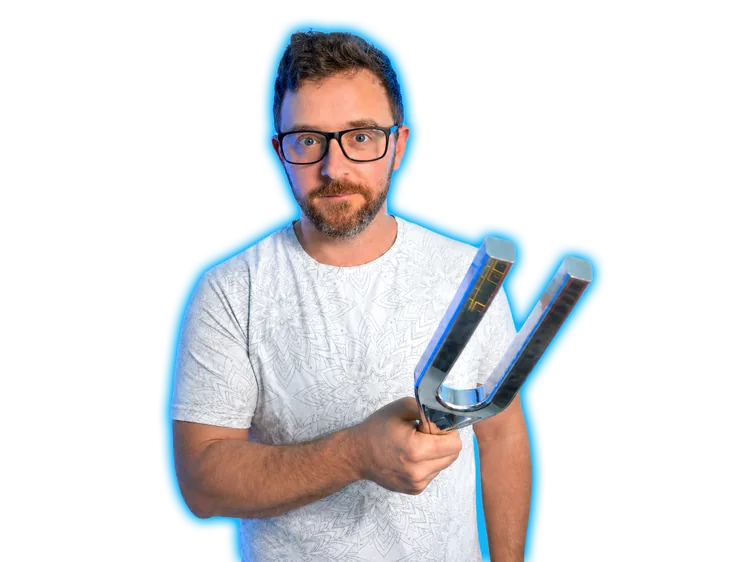
Get tuned with Chance
Tuning forks find where energy is stuck in the field around your body and bring it back into flow. Sessions over Zoom, recorded for you to keep.
30 Minute Consultations
Have something to look at, or looking for guidance? We can consult oracular tools, read your chart, or just talk through whatever you choose.
In this episode
Core themes
Loki's Staff and the Secret Letters
Chance Garton described a Celtic god of eloquence, shown with golden chains running from his mouth to his followers, as the model for Loki, and he read Loki's scepter as a caduceus for secret communication with a black robed priest figure. He argued that secret letters were once carried on staves and that writing itself was a form of telepathy. Gabe added a cipher he learned about while studying the Voynich manuscript, a strip wrapped around a staff of fixed thickness. Chance then speculated, in his words high octane speculation, that horses might be symbolic secret messengers in Kabbalah.
Thor, Grief and Hero Trauma Arcs
Chance said Thor was a character many men identified with and that his collapse into grief, shown as weight gain and drinking, could plant a dangerous neural pathway in viewers who would all lose someone eventually. He asked whether trauma arcs worked as hooks that made zeroing out seem like an acceptable response. Gabe described a scene he had watched that day in which another character shook a despairing hero out of backing down. Chance also noted that Thor and Odin imagery was associated with nationalist movements, so identifying with them could draw labels. Gabe said he had once identified strongly with Thor.
Tony Stark as Yoni Stork
Chance explained why he had called Tony Stark Yoni Stork, reading the giant whale monsters in the Battle of New York as a cue for the story of Jonah, whose name he linked to a Hebrew word for dove. He described Tony as the dove released from the Ark and as a savior figure whose arc reactor echoed the Ark. Gabe tied Tony to the hierophant, chariot and hermit cards, saying the red and blue of the suit matched the paired sphinxes of the Rider-Waite chariot, and agreed that calling him Yoni Stork was fully allowed. Chance added that technology originally meant technical language.
Blue Beam Fears and the Idea of Demons
Chance said the portal in the Battle of New York was projected from a blue beam and that alien invasion fears were echoed throughout the film. Gabe argued that the blue beam operation had been running since the film Avatar, which he said primed audiences to feel sentimental about blue light. One of the hosts suggested the real alien might be a disembodied consciousness, and Chance described a holistic view in which demonic attachment could be a person's own fragmented life force energy. A chat member also posted a Hebrew term for paganism that Chance wanted to revisit.
AI, the Statesman and Hail Hydra
Chance read Ultron as a symbol of artificial intelligence, wondering aloud whether energy trapped in closed circuitry might be a kind of demonic construct. Gabe replied that intelligence is not consciousness and that tools can only imitate feeling. Chance described the ship called the Statesman in Infinity War as a wink from the filmmakers, and Gabe tied the Marvel Studios logo to the number ten and to what he called diablo ex machina, a satanic ending that leaves audiences without resolution. Gabe also offered a metaphor from the Hail Hydra scene, saying one drop of truth could reveal who was awake.
Quotes
“What blows my mind about the Avengers movies is how every major scary psychological operation under the sun in the last hundred years is in some way echoed or reinforced, or, you know, the thumbs in the eyeballs pressed in deeper on these different things.”
“Yoni symbolism is dove symbolism, they go hand in hand, and the yoni, the dove being released from the Ark in so many different versions of the myth, is the point of course where we know that we've been saved. So Tony and yoni rhyming, he actually is the Jonah figure in so many ways, he's the one that is the savior.”
“In a sense the magic of letters and writing in general is that it's actually telepathy, that you are transmitting an idea directly from your mind into another mind.”
“But then what happens with the loss and the grief that is incorrectly processed or not able to be emotionally dealt with, Thor winds up like fat, overweight, drunk, just watching TV all day and becomes a loser due to his loss. That is a dangerous neural pathway to forge for people because everybody's going to lose somebody in their life.”
“What happens whenever you put the electricity into a closed loop circuitry that has a mimicking of a neural network or a brain or a human body, but it doesn't have that silver cord out to source, or the cord that it has is to the internet, you know, a limited but it's a simulated collective mind or source?”
“There's this part in the film where she infects the minds of the various Avengers by giving them a vision of their worst fear coming to life, so invoking their trauma to control them and alter their behavior. It's like trauma-based mind control.”
“The very next thing they say is Mayday, Mayday, the Statesman, the citizenship is going down. It's a massive tip of the hand, that they're, you know, a little wink to people like us. They're like, yeah, we're hip to the spiritual element of all this legal sorcery, but none of these sheeple are gonna get it.”
“I learned some forms of code, historical, well-known, time-tested forms of code, and one of them is you take a staff of a designated thickness uniformly, and you take a strip of whatever, paper, probably leather, and you wrap it around the staff and then you write your message linearly from one strap to the next.”
“I often point out that intelligence is not consciousness. So when people say artificial intelligence is going to do all these things, well, it will never have feelings, it can never have feelings, it will always be a tool, and tools don't have feelings, they don't have sentimentality, they don't have intuition, they never will, they can only imitate and emulate.”
“If they want to see who's awake and who's aware and who's savvy, all they have to do is seed one little droplet of the truth, and then they can see the connectivity of what's going on underneath the surface by how responsive we are to the truth.”
“It was an analysis of Friedrich Nietzsche's Birth of Tragedy, it was his final chapters, and he culminates the whole thing, like the very end, one of the last weaves that he throws out there is, he's actually speaking of how powerful and useful dissonance is, and it just hit me like a ton of bricks.”
“What I think we're seeing with all this programming is, on a very subtle level, they are making sure that the mythology of the sky is embedded in our consciousness in some way, shape, or form, with consistency, with the full scaffolding of the heavens subtly seeded into our mind in ways that very few fully appreciate.”
“Generally the machine somehow on a subconscious level is going to imply that it is the state, that the government is going to save you in the end. That's an old trope, and we talked about this last night, that now there's this new thing where it's like diablo ex machina, where something satanic is going to come at the end and leave you with no sense of resolution whatsoever.”
Gabriel, known on air as Slick Dissident, co-hosts InnerVerse's Vibe Rant show and is a longtime recurring guest on the podcast. He teaches occult symbolism and tarot on his YouTube channel, ranging across the Major Arcana, the esoteric Enneagram, mythology and archetype, mystic linguistics, and the symbolism hidden in popular film. He is best known for Tarot-tories, his own system mapping the 22 Major Arcana and zodiac archetypes onto the geography of the United States.
See all Gabe episodes→Kyle and Serena Denton are community herbalists creating wild-crafted and organic plant medicines out of Milwaukee since 2015. I have used their teas and tinctures on an almost daily basis for years now. Kyle is a great friend of InnerVerse and has appeared on the channel more times than I can count. These products work, not in the allopathic "pharma-medicine" way, but in a terrain-support, consciousness bolstering plant-teacher sort of way.