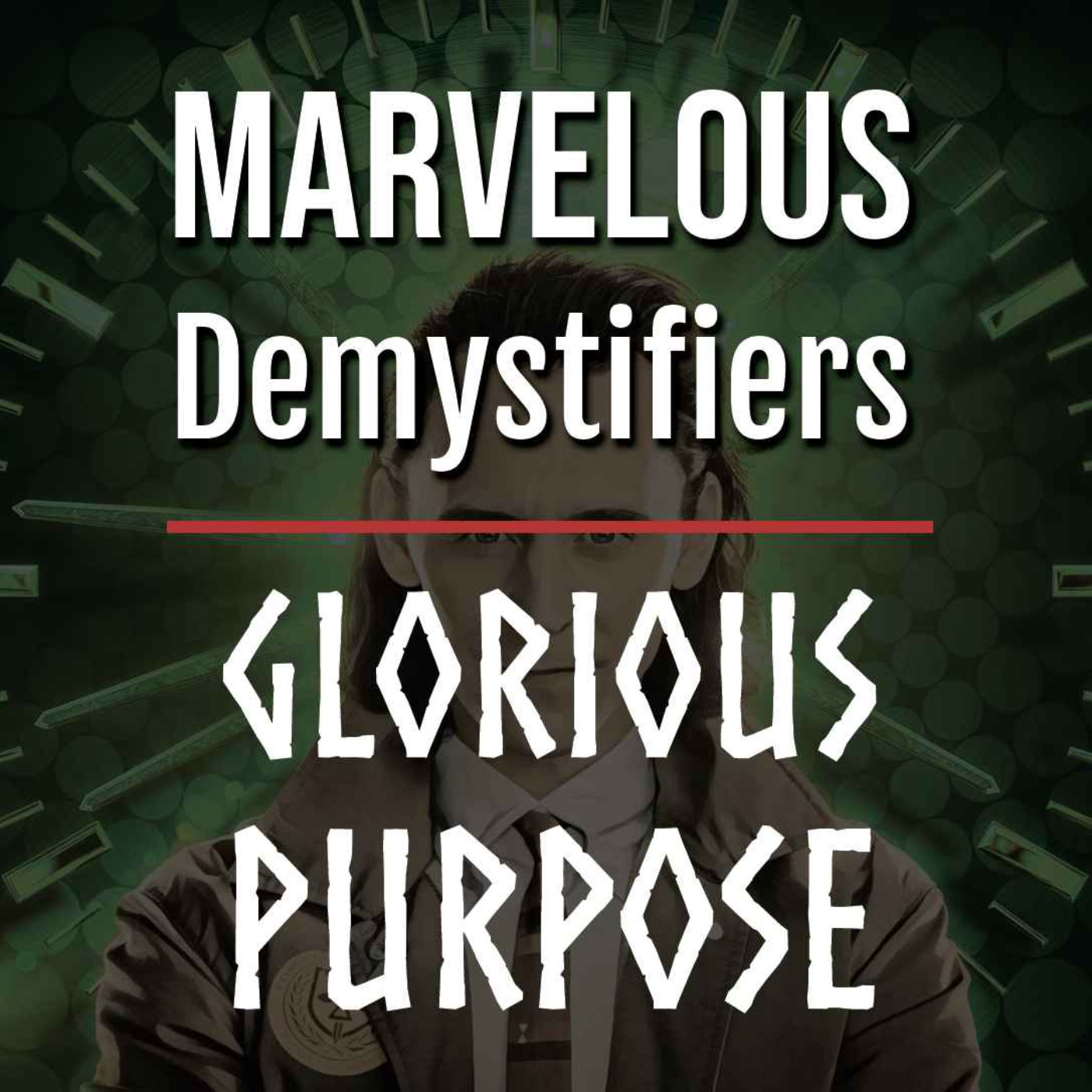
For All Time Part 2, The Alchemical Marriage of the Demiurge: Loki S1 E6 | Marvelous DeMystifiers 22









One stream wasn't enough to cover all the crazy symbolism in this final episode of Loki, Season 1. We will continue to explore the Tower pathway of the Kabbalistic Tree of Life, the letter Pey and Gematria of 80, the alchemical marriage, the serpent and the dove, and a lot more. Join us as we finish this deep dive into: For All Time, Always.
 Plus+InnerVerse Plus+
 InnerVerse Plus+
Hear every full episode
Every extended episode, the complete Plus+ archive, premium video and a private podcast feed for your app.
Cancel any time.

Get tuned with Chance
Tuning forks find where energy is stuck in the field around your body and bring it back into flow. Sessions over Zoom, recorded for you to keep.
30 Minute Consultations
Have something to look at, or looking for guidance? We can consult oracular tools, read your chart, or just talk through whatever you choose.
In this episode
Core themes
The Tower Path and the Alchemical Marriage
Chance presented the final Loki episode as a climb up the Tower path of the Kabbalistic Tree of Life, between Hod and Netzach, and tied it to the letter Pey and the gematria of 80. He read Loki and Sylvie as the thinking and feeling pillars who rise toward an alchemical marriage. Chance said the elevator ride, the falls backward and the closing kiss all matched Tower and Fool imagery, and he argued that Pey, meaning mouth, explained why the two joined mouths at the climax.
Straw Man Files and the Power of Names
Chance read Renslayer's moment with digital and paper files as a picture of the legal straw man, noting that ren is an Egyptian word for name and that file is an anagram of life. He argued that a search engine returned results to a person's straw man, shaped by history and by whoever programmed it, and tied Miss Minutes to that gatekeeping role. He also said the show designers had claimed Hearst Castle as an inspiration, and read newspapers as an old form of timeline control.
Gabe on Enneagram Mobius and Protestant Kings
Gabe opened by describing a MacGuffin reading in which Mobius's fixation on watercraft stood in for Zen and the Art of Motorcycle Maintenance. He said the book's author had forgotten a former self he named Phaedrus, which Gabe matched to the number one Reformer on the Enneagram, while he placed Mobius at number seven. Gabe called the Enneagram a bedrock of social engineering, proposed using it to test whether a film left viewers integrated or disintegrated, and later said the Protestant reformation had made each person a sovereign king.
Kang as the Hidden One and the Apple
Chance read the missing fourth Timekeeper statue as the hidden one, Ammon of Siwa, and linked Siwa to Shiva, suggesting He Who Remains was a Jupiter, Amun and Shiva figure. He tied the fortress crown of Immortus to Chronos and read the apple as the serpent's fruit of gnosis, arguing that the idea of the serpent was wrapped up in the word apple itself. Chance also said the devil at the top of the Tower could be understood as God acting as author of all things, with evil serving good in the long run.
The Eight Step Mechanism and the One Life
Chance laid out the writers' eight step cycle, in which a protagonist needs something, goes on a quest, pays a price and returns changed, and he read it as both good storytelling and a tool of social engineering. One of the hosts traced irony to a Greek word for a dissembler, and Chance argued that doing harm now for a better future could not work because only the present existed. Chance also described the sacral center as the seat of free will, saying that hunger and enthusiasm shaped how time was felt.
Quotes
“I think this might be the most fun way to teach symbolism that there is. So for me, it's a learning experience. It's a teaching experience. I get to pull together the threads of things I'm aware of and forge new links so that I'm able to recall them better in the future.”
“I'm realizing that the MacGuffin has the symbolic attachment to other real world analog where the rubber meets the road in manipulating the psyche of the collective, the grand homunculus of us all.”
“They are hailing only to those in the know that the Enneagram is the bedrock of social engineering, it always has been, it always will be. And I'm just learning this now when I've been on this Enneagram project for almost a year. And they are laying out my work in front of my own eyes in this film confirming that I am nailing it, bro.”
“You sit down at your search engine or you sit down at social media or whatever it is that you're engaging with the digital realm. And you think that it's you that's searching for whatever it is you're looking up. But what's actually happening is your straw man is searching for it. And your straw man has a digital record of everything that it's ever done.”
“But that which we think of as the devil or as such is at the top of the tower is God. He's writing the divine comedy and tragedy. He's authoring evil. But what humanity often fails to comprehend is that evil always serves good. So in the long run, when everything comes back around, there never was any evil to begin with. There was just temporal evil, temporary evil.”
“The power of looking at these series like we do as the allegories that they are is that hopefully this can take something like Kabbalah out of the realm of just being Hebrew words and memorizing correspondences like flashcards that you're trying to keep all straight, to the realm of actually seeing it in the world.”
“I'm saying your free will exists in the sacral region in how much you do or do not want to be doing or experiencing what you're experiencing, and that is what affects the flow of time. And so when you get to the point of ultimate hunger, ultimate desire, ultimate openness of that gate of Yesod, that is when time can actually slow down or pause.”
“This is the mechanism. This mechanism for your good or ill, but this is good story writing and this is good social engineering. It works on many levels. This is based in a simplified, refined, scientifically applied version of the hero's journey.”
“What we're seeing in this show is actually an example of what I'm talking about here. How could they pack so much into this show? Do they really know all this stuff that we're talking about? No, man, they generated this through their creative faculties. And that means God made it. That means that Chronos made it. That means that the one life is what generated this.”
“There's so many responsibilities, burden draped onto the individual because we are all kings, that we become like a Christ, carrying a huge burden of all the things to do, all the bills that we have to meet in this purple robe of suffering on top of that.”
“This is how we can test film to see if it's an integrating experience for the watcher or if it's a disintegrating experience for the watcher. And that is to say, we can actually determine if the film was beneficial for society or if it was detrimental for society.”
“Love opens up because love is infinite possibility. And the restriction, fear, there's only one thing can happen. That's how fear operates. Love is like anything can happen. I'll be fine with it.”
Gabriel, known on air as Slick Dissident, co-hosts InnerVerse's Vibe Rant show and is a longtime recurring guest on the podcast. He teaches occult symbolism and tarot on his YouTube channel, ranging across the Major Arcana, the esoteric Enneagram, mythology and archetype, mystic linguistics, and the symbolism hidden in popular film. He is best known for Tarot-tories, his own system mapping the 22 Major Arcana and zodiac archetypes onto the geography of the United States.
See all Gabe episodes→Kyle and Serena Denton are community herbalists creating wild-crafted and organic plant medicines out of Milwaukee since 2015. I have used their teas and tinctures on an almost daily basis for years now. Kyle is a great friend of InnerVerse and has appeared on the channel more times than I can count. These products work, not in the allopathic "pharma-medicine" way, but in a terrain-support, consciousness bolstering plant-teacher sort of way.