The Great Whiteboard Brotherhood vs. The Infinite Paradox









Prepare to divide your mind by zero! The Great Whiteboard Brotherhood returns to collaboratively ponder our current philosophical studies--joining tonight are some of our favorite sages, Slick Dissident, and PK. The central question of our roundtable tonight is this: can we actually know anything about the infinite? Tune in and buckle up for a metaphysical showdown against Zeno of Elea and just about every mathematician that ever reckoned a calculus.
 Plus+InnerVerse Plus+
 InnerVerse Plus+
Hear every full episode
Every extended episode, the complete Plus+ archive, premium video and a private podcast feed for your app.
Cancel any time.
Get tuned with Chance
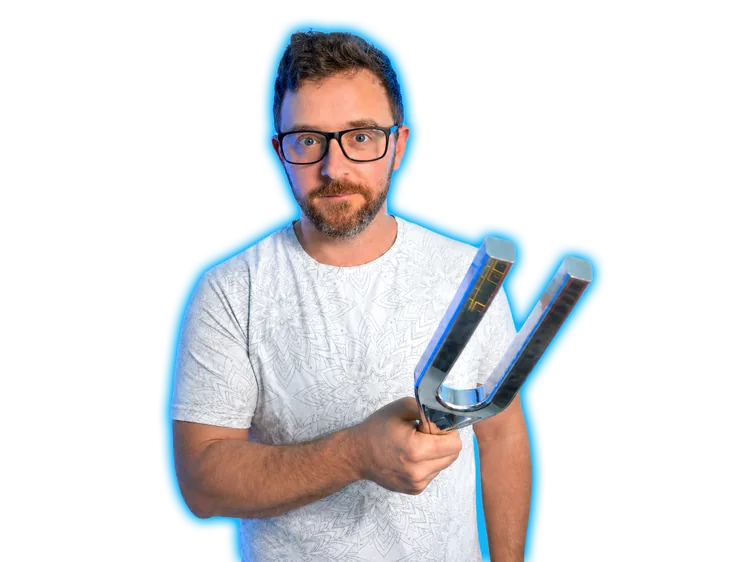
Tuning forks find where energy is stuck in the field around your body and bring it back into flow. Sessions over Zoom, recorded for you to keep.
30 Minute Consultations
Have something to look at, or looking for guidance? We can consult oracular tools, read your chart, or just talk through whatever you choose.
In this episode
Core themes
Infinite versus indefinite
Chance builds the night on a distinction he takes from Rene Guenon's book on the metaphysical principles of the infinitesimal calculus: the infinite is that which has no limits whatsoever, so on this reading it can only be the universal all, while anything measurable, countable or attached to a unit stays inside the finite. Endless addition or endless halving, he argues, produces the indefinite rather than infinity. That is why he rejects Pascal's picture of humans as infinitely small beside the universe and infinitely large beside a dust mite, since two infinities would limit and cancel each other out.
Zeno's paradoxes and the case against atomism
On the whiteboard Chance draws Achilles chasing a tortoise, halving the gap forever, then reports Guenon's claim that Zeno was probably not denying motion at all. The likelier target, on that account, is the atomist assumption of an irreducible multiplicity, because a continuum assembled from points or final indivisible particles would not be continuous and nothing could move through it. He cites a Scientific American piece on quantum physics reopening the paradoxes, and the whirling ember that the eye reads as a circle of fire. His summary: reality cannot be continuous and discontinuous at the same time.
Four cardinal virtues, four different Greek words
PK shares his screen and walks through sophia, andreia, sophrosyne and dikaiosyne, arguing that English flattens four distinct Greek terms into an interchangeable mush of wise, brave, sober, prudent, temperate and clever. He notes that the verse about being wise as serpents uses a phren word rather than a sophia word, and that the Vulgate and the King James render the same term differently. Chance adds that phren also sits inside diaphragm, tying mind to breath and heart. PK's practical advice is the Perseus lookup site, and reading two lines slowly rather than a whole chapter.
Vortiginous words and the nodding judge
Slick Dissident offers his own coinage, vortiginous, for words that spin listeners until discernment gives out. He traces the idea to Aristophanes and Plato, describing what he calls the open yawn of a nodding judge, the moment an audience stops testing a claim because following it has become too much work. The word all is his favourite specimen. His antidote is circumspection, tracking every detail without getting dizzied. The group extends this to syllogisms, advertising and the fallacy of affirming the consequent, which Chance says quietly props up a great deal of what passes for science.
Knowledge, understanding, and taking the logic back
PK relays a formula he credits to J.G. Bennett, a follower of Gurdjieff: knowledge can be communicated but not transferred, while understanding can be transferred but not communicated. Nobody can hand over a cheat sheet of letter swaps and pass along the understanding behind it. That feeds the show's running argument that people defer to expertise because every field has grown into a labyrinth, and that the repair is to walk back to the foundations and challenge the ground itself. Chance ties it to his Mark Gober conversation: choose your ground, or somebody else chooses it for you.
Quotes
“Is our universe made of discrete continuous or discrete non-continuous particles or is it a big continuum?”
“What happened to the S.S. Yorktown, this big powerful implement had been rendered impotent by just one tiny error.”
“That's not infinity. That's called indefinite. That means that it's something that's within the realm of the finite because it's measurable, right?”
“They're circumventing your discernment. And so the open yawn of a nodding judge is earned by vortiginous words.”
“And it's about damn time that we go, hold on just a minute, explain what you mean and just stop blindly following this stuff.”
“We're almost, you know, lost in the sauce of this indefinite language. It's in our science, it's in our math, it's in our ways of communicating.”
“So this individual in the story that Aristophanes tells is the foundation of atomism. It's the foundation of democracy. It's the foundation of comedy.”
“So knowledge is something that can be communicated, but not transferred. Understanding is something that can be transferred, but not communicated.”
Gabriel, known on air as Slick Dissident, co-hosts InnerVerse's Vibe Rant show and is a longtime recurring guest on the podcast. He teaches occult symbolism and tarot on his YouTube channel, ranging across the Major Arcana, the esoteric Enneagram, mythology and archetype, mystic linguistics, and the symbolism hidden in popular film. He is best known for Tarot-tories, his own system mapping the 22 Major Arcana and zodiac archetypes onto the geography of the United States.
See all Gabe episodes→Kyle and Serena Denton are community herbalists creating wild-crafted and organic plant medicines out of Milwaukee since 2015. I have used their teas and tinctures on an almost daily basis for years now. Kyle is a great friend of InnerVerse and has appeared on the channel more times than I can count. These products work, not in the allopathic "pharma-medicine" way, but in a terrain-support, consciousness bolstering plant-teacher sort of way.